

How to Choose an Industrial Exhaust Fan for a Welding Shop
Choosing an industrial exhaust fan for a welding shop starts with the contaminant control method—not the fan diameter. Capture fumes close to the arc, calculate airflow at each extraction point, account for system resistance, and select a fan that delivers the required airflow at that static pressure. General exhaust can remove heat and residual contaminants, but it does not replace source capture where exposure control is required.
Start with the Welding Process and Exposure-Control Plan
A fan supplier needs more than floor area. Record the welding processes, metals, consumables, operating hours, simultaneous stations, and whether workpieces stay in fixed positions. Stainless steel, coated metal, and confined-space work may require additional controls.
Local exhaust ventilation (LEV) should normally be the first engineering consideration because it intercepts fumes before they enter the breathing zone. Options include extraction arms, downdraft tables, backdraft hoods, and on-torch extraction. General ventilation supplies replacement air and removes heat or escaped contaminants.
Have a qualified professional assess exposure and local requirements. Hood design, ductwork, filtration, discharge, controls, and maintenance all affect performance.
Calculate Airflow at the Capture Point
For each hood, determine the airflow needed at the actual working distance. A simplified starting relationship is:
Q = V × A
where Q is airflow in m³/s, V is average velocity in m/s, and A is effective opening area in m². This relationship applies at the hood opening; hood geometry, cross-drafts, worker position, and capture distance must also be considered.
Add the design airflow for points operating simultaneously. Account for verified automatic dampers and diversity where appropriate. Allow for leakage and operating variation, but avoid arbitrary oversizing: excessive airflow increases energy, noise, make-up-air demand, and treatment volume.
An existing DAIHO guide explains how to calculate air changes per hour (ACH) for industrial ventilation. ACH can help estimate room-level dilution or heat removal, but hood airflow should be based on capture requirements.
Determine the Total Static Pressure
Airflow alone does not define a fan duty point. Calculate losses through ducts, fittings, dampers, hoods, filters, safety devices, and the discharge terminal. Check filters pressure drop under both clean and loaded conditions. The duty point is the required airflow at the calculated total static pressure.
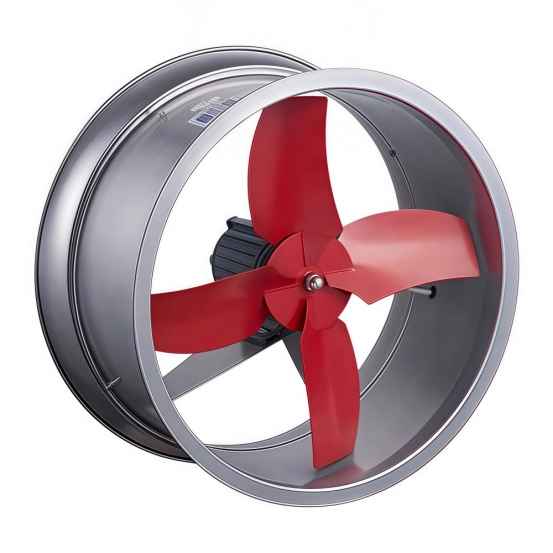
An axial fan can move high air volumes efficiently when resistance is low. A centrifugal fan is often better for higher-resistance ducted extraction. This axial vs. centrifugal fan comparison is a useful starting point, but every model should be checked against its performance curve at the proposed duty point.
Match the Fan Type to the System
Use the following framework before comparing individual models:
| System Condition | Fan Direction to Evaluate | Main Verification |
| Short, low-resistance wall exhaust path | Wall-mounted axial exhaust fan | Airflow at installed resistance, shutters, weather protection, and make-up air |
| Low-to-moderate resistance transfer or supply path | Ducted axial fan | Pressure capability, sound, mounting, and access for service |
| Long ducts, multiple fittings, or filtration | Centrifugal fan | Full system curve, clean/loaded filter pressure, and motor load |
| Corrosive moisture or process atmosphere | Compatible corrosion-resistant construction | Material compatibility for housing, impeller, fasteners, seals, and motor environment |
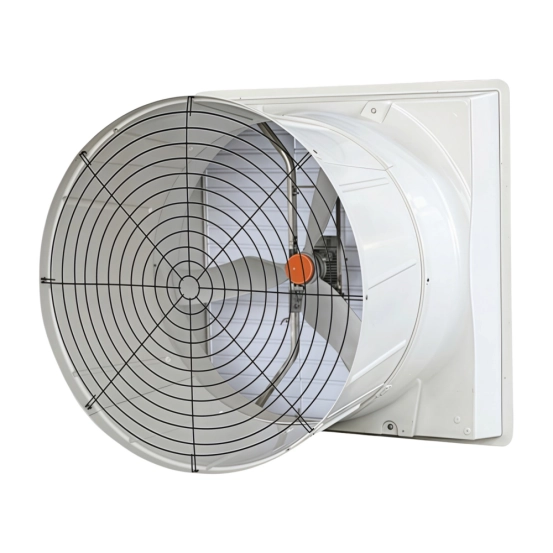
DAIHO Ventilation’s wall exhaust fan can support general factory exhaust where pressure requirements are suitable. Its industrial ventilation and factory cooling solution places fans within a broader airflow strategy.
Check Materials, Motor Location, and Discharge Design
Provide the expected contaminant composition, temperature, moisture, and particle loading. Confirm that all materials exposed to the airstream are compatible. A corrosion-resistant housing alone does not make an assembly suitable for every fume or hazardous atmosphere.
Metal deposits may affect the impeller, ducts, filters, and fire risk. Determine whether spark control, fire protection, or special cleaning access is necessary. If combustible dust or a classified location could be present, use equipment approved for that condition.
Locate the discharge to prevent re-entry through openings or air intakes. Provide replacement air without creating cross-drafts through the breathing zone or across the hood.
Review the Supplier’s Selection Data
Before issuing a purchase order, request and compare:
- A fan curve showing the proposed duty point, rather than a free-air airflow value
- Motor power, voltage, frequency, speed, enclosure, and control method
- Sound data at stated test conditions
- Housing and impeller materials, coating, and corrosion limitations
- Maximum air temperature and any particle-loading limits
- Installation orientation, vibration isolation, guards, and service access
- Cleaning procedures, bearings, belts, and spare-parts availability
- Filter pressure-drop range and the control response as filters load
A variable-frequency drive can adjust flow when equipment is suitable, but commissioning is still required. Verify airflow, rotation, vibration, motor current, branch balance, make-up air, and hood performance. Recheck after system or process changes.
Avoid Common Welding-Shop Ventilation Mistakes
The most common error is selecting a fan based on its catalog airflow rating while ignoring system pressure. Others include placing a wall fan far from the source, treating room ACH as proof of capture, discharging near an air intake, omitting replacement air, and ignoring loaded filters. An oversized fan can create drafts and noise without fixing a poorly positioned hood.
Shorter ducts, smoother fittings, efficient fan selection, clean filters, and controls linked to active stations can reduce resistance and unnecessary operating hours.
FAQ
These questions address practical decisions that commonly arise during early system planning.
Can a Wall Exhaust Fan Remove Welding Fumes by Itself?
It may remove accumulated contaminants and heat, but it does not ensure capture at the arc. Where exposure must be controlled, evaluate LEV at the source and use general exhaust as support.
Should I Use an Axial or Centrifugal Fan for Welding Exhaust?
Choose from the duty point. Axial fans suit high airflow at lower resistance; centrifugal fans often suit long or filtered duct systems. Confirm the choice on the fan curve.
How Much Airflow Does a Welding Booth Need?
There is no universal value. Airflow depends on hood design, capture distance, process, cross-drafts, and simultaneous stations. Calculate each hood and verify capture during commissioning.
Does the Exhaust System Need Make-Up Air?
Yes. Unplanned negative pressure can reduce fan flow, affect doors or combustion appliances, and create cross-drafts. Design the supply path to support capture.
How Often Should the System Be Inspected?
Base the interval on operating hours, contaminant loading, filter behavior, and local requirements. Inspect hoods, ducts, filters, fan condition, airflow indicators, and discharge paths.
Prepare a Better Fan Selection Request
Send the supplier a shop layout, hood and duct drawings, required airflow, calculated static pressure, welding schedule, contaminant and temperature information, electrical supply, installation location, and controls. Contact DAIHO Ventilation and submit these details for a model review or quotation. Qualified local professionals should confirm the final exposure-control design and compliance.
 English
  Russian
  Arabic
  Spanish
  French
  Italian