

Cooling Pads Explained Thickness, Air Velocity, Efficiency, and Maintenance

Cooling pads look simple: wettable media held in a frame. Their role in the system is more complex. A pad must stay evenly wet while allowing sufficient ventilation airflow. It must do this without excessive pressure loss or water carryover. Pad thickness, face velocity, and outdoor humidity all affect performance.
What Is a Cooling Pad and How Does It Work?
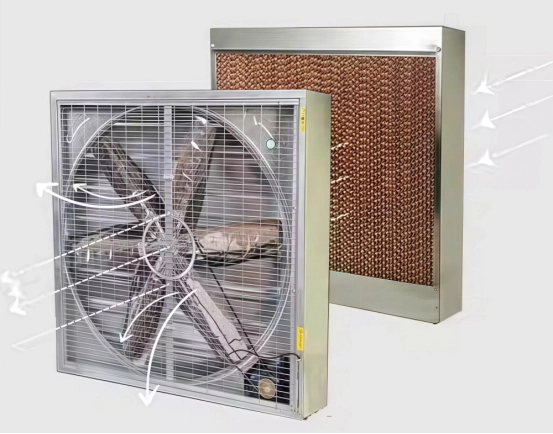
A cooling pad is the heat-transfer medium in a direct evaporative cooling system. Warm outdoor air passes through wetted channels. Water evaporates and absorbs sensible heat. Supply-air temperature falls while moisture content rises.
The system needs a pump and distribution header. A sump collects returning water. Fans pull air through the pad. DAIHO Ventilation’s guide to how evaporative cooling systems work explains the full cycle.
Outdoor dry-bulb and wet-bulb conditions establish cooling potential. Airflow determines how effectively cooled air reaches the occupied zone.
How Cooling Pad Thickness Affects Performance
Pad thickness changes contact time and resistance. Select the thickness based on the required duty point, not the assumption that more material always produces more cooling.
Common Cooling Pad Thicknesses
Common thicknesses include 100 mm, 150 mm and 200 mm. A 100 mm pad suits compact installations low resistance is important. A 150 mm pad can provide a balance between efficiency and pressure drop. A 200 mm pad provides a longer air path but needs more wall depth and fan pressure.
| Pad Thickness | Typical Advantage | Main Consideration |
| 100 mm | Lower resistance and compact installation | May provide less contact time |
| 150 mm | Balanced efficiency and pressure drop | Requires correct fan matching |
| 200 mm | Longer air-to-water contact | Higher resistance and installation space |
Thicker Is Not Always Better
A thicker pad may improve evaporation at a given face velocity. It also adds resistance. If the fan cannot overcome that pressure drop, airflow falls. The air may be cooler at the pad but provide less effective cooling in occupied areas.
This appears in long poultry houses. A pad upgrade may look successful near the inlet while airflow or airspeed at the far end decreases. Check fan performance and leakage before blaming the medium. Properly selected industrial exhaust fans belong in the same calculation.
Why Air Velocity Through the Cooling Pad Matters
Pad face velocity is airflow divided by effective pad area. Gross wall dimensions can be misleading when frames reduce usable area.
Excessive velocity shortens contact time. Pressure drop rises and droplets may be pulled downstream. Wet floors near an inlet often indicate poor distribution or excessive velocity.
Very low velocity leaves pad area underused and may result in insufficient ventilation. Match the fan using tested pressure-drop data at operating resistance—not free-air airflow.
What Determines Cooling Pad Efficiency?
Saturation efficiency describes how closely leaving-air temperature approaches the outdoor wet-bulb temperature. It does not promise a fixed temperature reduction.
Hot and relatively dry air has more cooling potential. On a humid monsoon afternoon, dry-bulb and wet-bulb temperatures sit closer together. A clean pad may produce only modest cooling. Adding more water will not overcome this climatic limit.
Pad profile and thickness affect performance. Face velocity changes contact time and resistance. Uneven wetting leaves dry channels. Scale and dust narrow air passages.
System layout also affects cooling performance. Short-circuited air near an exhaust opening can leave floor level warm. A properly designed evaporative cooling system controls both air and water paths.
How to Select the Right Cooling Pad
Selection starts with site conditions and a realistic cooling target.
- Record the summer design temperature and relative humidity.
- Define the target zone and acceptable indoor condition.
- Calculate the ventilation airflow needed for the building or process.
- Establish the effective pad wall area available.
- Divide airflow by that area to find pad face velocity.
- Compare efficiency and pressure drop at the calculated velocity.
- Select fans against the complete system resistance.
- Check water quality, drainage and maintenance access.
For a retrofit, measure airflow before ordering pads. In one factory bay, a dirty inlet screen created more resistance than the aging pad. Replacing the pads alone would not have restored airflow. Assess industrial cooling equipment against climate and delivered airflow.
Cooling Pad Maintenance Checklist
Pad condition changes gradually. Routine inspection can identify problems before hot weather exposes them.
Routine Inspection
- Check the pad face for dry bands and collapsed sections.
- Confirm that water reaches the full width of the distribution header.
- Remove loose dust without crushing the pad surface.
- Inspect the sump, pump and filter for debris.
- Look for leaks or standing water around the frame.
Water Quality and Scale Control
Minerals remain as water evaporates. Without controlled bleed-off or water replacement, their concentration rises. White deposits form and restrict airflow.
Clean the reservoir before sediment reaches the pump. Do not use a pressure washer or aggressive chemical on cellulose pads. The surface may look clean while its internal structure is damaged.
Seasonal and Replacement Maintenance
Allow pads to dry periodically when operation permits. Persistent wetness encourages biological growth. Before cooling season, inspect seals and frames. Test the pump and every fan stage.
Replace media that sags or remains blocked after approved cleaning. Permanent dry areas are another warning. Replacement should restore wetting and airflow—not substitute for water management.
Common Cooling Pad Problems and Their Causes
Most cooling-pad faults leave a visible pattern. Record its location before changing settings.
| Problem | Possible Cause |
| Uneven cooling | Blocked water holes or poor water distribution |
| Reduced airflow | Dust, scale, blocked pads or inadequate fan pressure |
| Water carryover | Excessive face velocity or excessive water flow |
| Algae and odor | Contaminated or stagnant water |
| Frequent pad damage | Incorrect cleaning or unsuitable chemicals |
Temperatures on both sides can help distinguish water-distribution faults from airflow problems. Pressure readings help when ductwork is involved.
Build a More Efficient Cooling System with DAIHO Ventilation
A reliable system begins with matched components. Pad thickness should be selected according to face velocity. Fans must deliver the required airflow at operating pressure. Water must cover the pad without flooding it.
DAIHO Ventilation supplies cooling pads and ventilation equipment for factories, farms and greenhouses. Fans and cooling equipment can be selected as an integrated system. Send building dimensions and local design conditions. The DAIHO Ventilation engineering team can review pad area, fan duty and water circulation against the application.
Frequently Asked Questions
Q: Is a 150 mm cooling pad always more efficient than a 100 mm pad?
No. A 150 mm pad provides a longer air path, but efficiency still depends on face velocity and wetting. A thicker pad can reduce airflow if available static pressure is inadequate.
Q: How often should evaporative cooling pads be cleaned?
Base the interval on dust load and water quality. Inspect pads during operation. Clean the sump and distribution system when sediment or uneven wetting appears.
Q: Can cooling pads work in a humid climate?
They can provide ventilation and some cooling, but the temperature drop decreases as outdoor humidity rises. Use local dry-bulb and wet-bulb conditions to estimate performance before specifying the system.
 English
  Russian
  Arabic
  Spanish
  French
  Italian