

Axial Fan vs Centrifugal Fan: Key Differences and Industrial Applications
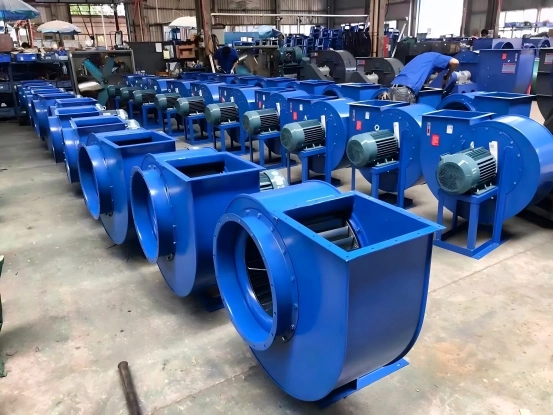
Industrial ventilation is not a contest to move the most air. A plant may need to clear roof level heat, extract welding fumes from a work area, or cool a packaging line. Axial and centrifugal fans respond to resistance in different ways. An unsuitable selection can lead to weak airflow, noise, and overloaded motors.
This guide compares the two fan types from an application engineer’s perspective. The required air path matters more than the label on the casing.
What Is an Axial Fan?
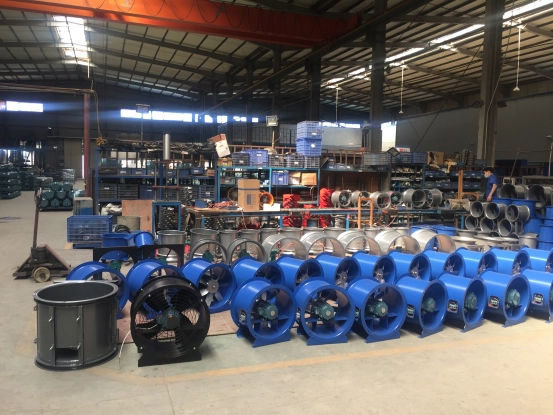
An axial fan moves air parallel to its shaft. Its propeller-like blades push a high volume of air through a wall opening, roof opening, or short duct. Its compact design is best suited to systems with low resistance.
Axial fans perform best at low to moderate static pressure. They are common in general exhaust, heat relief, and negative pressure ventilation. In a warehouse, roof fans extract rising heat while make-up air enters through planned openings.
Treat free air capacity cautiously. Louvers, guards, and transitions add pressure loss, so installed airflow will be lower.
Common Axial Fan Applications
Axial fans serve factories, warehouses, greenhouses, poultry houses, and workshops. They suit air exchange, heat removal, and evaporative cooling support.
What Is a Centrifugal Fan?
A centrifugal fan draws air into the impeller center, then turns it outward into a housing and discharge. This design allows the fan to develop higher static pressure. It suits air paths containing hoods, filters, dampers, or long ducts.
Impeller selection matters. Backward curved wheels are efficient air handlers. Radial blades can tolerate dirtier air. Check the contaminant, pressure curve, and motor limit.
Centrifugal fan needs more space. That additional space is justified when the system has restrictive ductwork
Common Centrifugal Fan Applications
Centrifugal fans serve ducted dust collection, fume extraction, air handling units, dryers, and boiler rooms. A welding hood connected to filters is a familiar case. Pressure losses, not free air airflow, decide the job.
Axial Fan vs Centrifugal Fan: Key Differences
The comparison should start with the required duty point: airflow at the actual static pressure.
| Comparison factor | Axial fan | Centrifugal fan |
| Airflow direction | Parallel to the shaft | Turns outward from the impeller |
| Air volume | Generally high | Moderate to high, depending on design |
| Static pressure | Low to moderate | Moderate to high |
| Best system | Open or low resistance | Ducted or high resistance |
| Installation | Compact and direct | Larger housing and duct connection |
| Typical duty | General exhaust and circulation | Process extraction and air handling |
The table gives the direction, not the final answer. The site does that.
Airflow Volume and Static Pressure
Axial fans suit high air change rates and uncomplicated paths. A hot warehouse may discharge warm air directly through wall or roof fans. The addition of filters or long duct runs can significantly change the pressure requirements.
Centrifugal fans trade compactness for pressure. They can hold airflow through a hood, duct, and filter. Specify CFM or m³/h at the required pressure.
Space, Installation, and Maintenance
An axial fan can be installed in a wall panel or roof curb. Outdoor units need cleaning access and weather protection. DAIHO Ventilation’s roof-mounted exhaust fan solutions fit this layout.
Centrifugal equipment needs room for its housing, connections, and service access. With either design, dirty blades can reduce airflow and increase motor load. Plan maintenance access before approval.
Energy Use and Total Operating Cost
Energy efficiency depends on the operating duty. Axial fans are economical for high volume, low pressure work. Centrifugal fans may use less energy when the system needs substantial pressure.
Controls, cleaning, run hours, and spares also affect cost. A low priced fan that misses its duty soon becomes expensive.
How to Choose Between an Axial and Centrifugal Fan
Walk the building before comparing catalogues. Mark each inlet, outlet, and restriction. This process can reveal many potential selection problems.
Choose an Axial Fan When:
- highvolume air exchange is the main requirement;
- ducts are short or absent;
- the building needs general exhaust or heat relief;
- installation space is limited;
- the application is a factory, warehouse, greenhouse, or poultry house.
Choose a Centrifugal Fan When:
- the system includes long ducts, filters, dampers, or several bends;
- a hood must capture dust, smoke, or fumes;
- static pressure matters more than maximum freeair volume;
- airflow must remain stable as resistance changes.
Check These Parameters Before Ordering
Confirm airflow and total static pressure. Record temperature, humidity, contaminants, corrosion risk, noise limits, dimensions, electrical supply, and operating hours. For evaporative cooling, check water quality, drainage, and seasonal humidity.
Industrial Application Examples
Real applications help show where the differences matter.
Factory and Warehouse Ventilation
A stamping workshop can trap heat under its roof while doors remain open. Roof or wall axial fans can remove this accumulated heat when replacement air has a clear route. Circulation improves comfort but does not remove heat.
Agricultural and Livestock Facilities
Poultry houses depend on controlled negative pressure. Axial fans provide volume while inlets and pads guide the air. DAIHO Ventilation’s evaporative cooling equipment is relevant where humidity and water conditions are suitable.
Ducted Dust and Fume Extraction
A welding line with capture hoods and filters has substantial pressure loss. A centrifugal fan is often the dependable starting point, provided its construction suits the contaminant. Select it with the hood and filter data.
Build an Efficient Ventilation System with DAIHO Ventilation
Share the complete application, not just the required fan diameter. Dimensions, heat sources, target airflow, duct layout, climate, utilities, and water limits make selection possible. DAIHO Ventilation manufactures and integrates exhaust fans, circulation fans, air coolers, cooling pads, and dehumidifiers. The range supports projects where exhaust and cooling work together.
Contact DAIHO Ventilation to submit your requirements, including clearly marked floor plans. The quotation should state duty points, assumptions, accessories, controls, and commissioning limits.
Conclusion: Match the Fan to the System
Axial fans generally suit high airflow, low pressure ventilation. Centrifugal fans are usually better for pressure heavy ducted work. Measure the air path, check the environment, and leave room for maintenance. These practical considerations can help prevent costly fan
FAQ
Q: Is an axial fan more energy efficient than a centrifugal fan?
Only at the right pressure. Axial fans suit high airflow with little resistance. Centrifugal fans may use less energy in pressure heavy ductwork.
Q: Can axial and centrifugal fans be used in the same facility?
Yes. A warehouse may use axial roof exhaust for general heat removal and a centrifugal fan for welding or dust extraction. Each fan needs its own duty calculation.
Q: What information should be sent to a fan supplier?
Send airflow, static pressure, temperature, humidity, contaminants, operating hours, installation dimensions, electrical supply, noise limits, and an air path drawing.
Q: Are roof-mounted axial fans suitable for every factory?
No. They suit direct exhaust and low resistance ventilation. A facility with long ducts, filters, or localized capture points may need centrifugal equipment or a mixed design.
Q: How can DAIHO Ventilation help with an industrial ventilation project?
DAIHO Ventilation can review the layout and operating data, then recommend relevant ventilation or cooling equipment for discussion.
 English
  Russian
  Arabic
  Spanish
  French
  Italian