

Warehouse Cooling Without Air Conditioning: 6 Energy-Efficient Alternatives
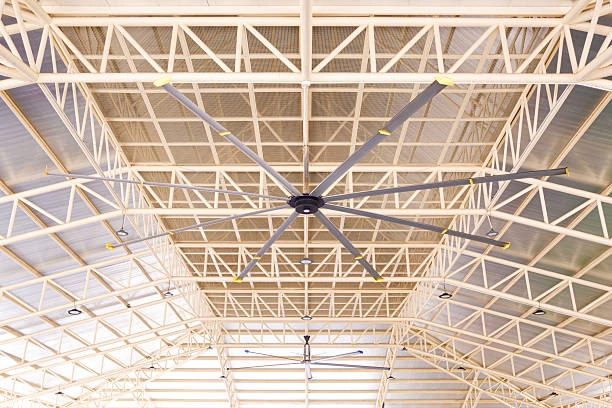
A warehouse does not need to be cooled like an office. The roof may absorb significant solar heat, the doors may stay open and the air volume can be enormous. Cooling the entire building with air conditioning is often expensive and can still leave hot pockets near the roof or loading dock.
There are practical alternatives. Air movement can improve comfort. Exhaust ventilation can remove heat above the racks. Evaporative equipment can lower incoming air temperature in suitable climates. Targeted cooling can focus on occupied work areas.
Why Warehouses Overheat Without Effective Airflow
Heat enters from several directions. A dark metal roof absorbs solar radiation. Forklifts and production equipment add heat. Open dock doors admit warm air. In a high bay building, the warm air rises and can form a hot layer above the occupied zone.
Humidity changes the picture. At high relative humidity, sweat evaporates slowly. Moisture can also damage cartons, labels and stored materials.
Walk the building during the hottest shift. Record temperature and relative humidity at floor level and near the roof. Note areas with little air movement. Ceiling height, rack layout and make-up air paths matter as much as equipment capacity. Roof insulation, a reflective finish and better dock seals can reduce the load before equipment is selected.
6 Energy Efficient Warehouse Cooling Alternatives
The six options below solve different parts of the problem. Some move air. Some remove heat. Others cool a smaller zone.
1. HVLS Industrial Fans for Whole Warehouse Air Movement
HVLS industrial fans move a large volume of air at low speed. At worker level, that air movement increases sweat evaporation and breaks up stagnant zones. In a high ceiling distribution centre, correctly placed fans can improve comfort across broad aisles without cooling every cubic metre of air.
The effect is comfort and destratification, not refrigeration. A fan will not remove heat generated by a furnace or battery-charging area. It needs clearances from lights, sprinklers, cranes and racking. Structural support must be checked before installation.
2. Roof and Wall Exhaust Fans to Remove Trapped Heat
Exhaust fans target the accumulated heat layer directly. Roof units discharge hot air where it accumulates. Wall units units can support cross-flow ventilation when paired with sized intake openings. This suits facilities where process heat is the main problem.
An exhaust only design can pull air through unintended paths. Dust may enter through gaps and conditioned rooms may lose pressure. Provide a deliberate make up air route with weather protection. A smoke test during commissioning often reveals a short circuit around the racks.
DAIHO Ventilation’s industrial ventilation equipment includes roof and wall exhaust options.
3. Industrial Evaporative Air Coolers for Dry and Hot Climates
An evaporative air cooler passes warm outdoor air over wet media. As water evaporates, it absorbs heat from the airstream. In a dry inland climate, cooling can be effective with modest electrical demand.
These units work well in open warehouses where fresh air can be exhausted continuously. Their cooling effectiveness is lower in coastal or monsoon conditions because humid air has less evaporation capacity. Water quality, drainage and cleaning also require ongoing attention from the operator, not just an installer.
Specify the design point using local summer temperature and humidity data. DAIHO Ventilation’s industrial evaporative air coolers are a starting point.
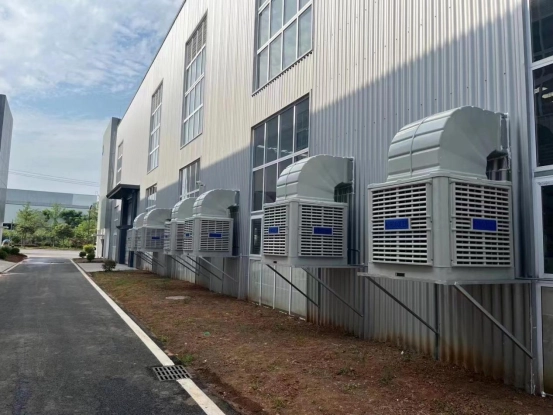
4. Evaporative Cooling Pad Systems with Exhaust Ventilation
Cooling pads and exhaust fans form a negative pressure system. Fans pull outdoor air through wetted pads, then draw the cooled stream across the building. The clear airflow direction helps in long production halls.
Cooling-pad area must be matched to the required fan airflow. If the pads are undersized, pressure rises and performance falls. Scale, algae and blocked water distribution are common failures. Drainage, filtration and cleaning access belong in the original layout.
The evaporative cooling systems supplied by DAIHO Ventilation can be considered where the climate and building envelope support this arrangement.
5. Spot Air Coolers for Workstations and Heat Zones
Cooling the entire building can be inefficient when only a few areas are occupied. A packing bench beside a south facing dock may need relief while storage aisles do not. Spot air coolers let the design follow the work.
Place the discharge where people stand. Keep forklift routes clear. Check whether the unit adds moisture or needs drainage. A targeted cooler can stabilise a small quality control room without changing the whole warehouse.
6. Misting Fans for Loading Bays and High Heat Areas
Misting fans combine air movement with fine water droplets. In a shaded loading bay, evaporation can take the edge off a hot afternoon. The equipment suits areas that cannot be enclosed.
Mist control is critical. Large droplets can wet cartons, create slippery floors or reach electrical panels. Water treatment and cleaning matter near the spray. In humid weather, the cooling effect can decline significantly.
How to Choose the Right Warehouse Cooling Alternative
Start with the failure you need to correct. High ceilings favour HVLS fans, while a hot roof layer points to exhaust ventilation. Dry weather supports evaporative coolers or pad systems. Spot units work well for concentrated heat zones, while misting fans may suit open loading docks.
If moisture is the main threat to comfort or inventory, add ventilation and consider an industrial dehumidifier as support. It manages moisture; it does not remove a large heat load.
Compare options using floor area, clear height, heat sources, summer conditions, water availability, maintenance access and noise limits. A low-cost unit that is difficult to clean may not remain efficient over time.
Why a Hybrid Cooling Strategy Often Works Best
Warehouses rarely have one uniform problem. Roof exhaust fans can remove the heat layer. HVLS fans can spread air across the floor. Evaporative coolers can serve production while spot units support packing and dispatch.
Controls should follow occupancy and outdoor conditions. Run exhaust during the hot shift, then reduce it when the building cools. Airflow should also be directed away from sensitive stock where necessary. DAIHO Ventilation’s solution and service support can help turn separate products into a workable airflow plan.
Get a Warehouse Cooling Assessment from DAIHO Ventilation
The most useful enquiry includes warehouse dimensions, ceiling height, climate, heat producing equipment, door schedules and problem areas. Photos are also helpful.
DAIHO Ventilation manufactures and integrates industrial fans, evaporative cooling equipment and humidity control products. Contact DAIHO Ventilation and share the operating conditions to discuss an approach sized for the actual building.
FAQ
Q: Can HVLS fans cool a warehouse without AC?
They improve perceived comfort and reduce air stratification. They do not remove the heat produced inside the building.
Q: Are evaporative coolers suitable for humid climates?
Their advantage is smaller in humid weather. Review local design humidity before choosing direct evaporative cooling.
Q: How do I size exhaust fans for a warehouse?
Use building volume, target air changes, heat load and intake restrictions. Estimating fan quantity from floor area alone can be misleading.
Q: What is the most energy efficient warehouse cooling solution?
It depends on the climate and the heat source. A hybrid system often uses less energy than cooling the entire building with AC.
 English
  Russian
  Arabic
  Spanish
  French
  Italian