

How to Select an Evaporative Cooling Pad for an Industrial Air-Cooling System
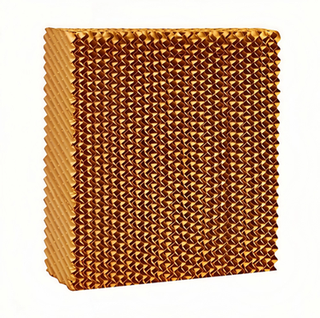
A buyer could copy “four 2000 × 600 mm pads, 200 mm deep” from a sketch into a purchase order. I would send it back for two additions first: the usable opening inside the frame and the fan duty with the wet intake attached. Those figures answer neither question on their own, and they say nothing about whether air crossing the pads will pass through the work area. Four outside rectangles add to 4.8 m²; they do not establish either answer. Until those points are drawn, the 200 mm depth is just a catalogue choice.
Put a route on the floor plan
On a blank floor plan, pads at one end and a fan at the other look reassuring. That is why I would mark where stock is normally stacked, where a delivery vehicle stops, and which doors stay closed. The path on the working plan may bend around a partition or run along an aisle that misses the machines. Put an arrow through the occupied zone, not just between the two walls. If no plausible arrow can be drawn, revisit the inlet and exhaust positions. A thicker pad will not turn a bypass route into useful ventilation.
The climatic brief needs more than a hot-day temperature. Ask the operator whether the difficult days are dry, humid, or both, and whether stored material or a process has a moisture limit. The pad cools through evaporation, so it also raises the incoming air’s water content. A supplier should see the local summer temperature and humidity used for selection. During commissioning, place the measurement in the occupied zone. The cool reading right at the intake is useful for diagnosing the pad, but it is not the worker’s condition.
Work from usable face area, not catalogue rectangles
The supplied DAIHO sheet is a dimensions list. For this selection, its useful distinction is between the standard sizes shown for 7090/6090 and the custom 5090 entry:
| Model | 7090 | 6090 | 5090 |
|---|---|---|---|
| H(mm) | 1000,1200,1500,
1800,2000,2100 |
1000,1200,1500,
1800,2000,2100 |
Custom-made on clients’ requirements |
| W(mm) | 900,600,300 | 900,600,300 | Custom-made on clients’ requirements |
| D(mm) | 100,150,200,300 | 100,150,200,300 | Custom-made on clients’ requirements |
| h(mm) | 7 | 7 | 5 |
| α(°) | 45 | 45 | 45 |
| β (°) | 45 | 45 | 45 |
H: Height of cooling pad; W: Width of cooling pad; D: Depth of cooling pad; h: Height of cooling pad corrugation; α: Angle of corrugation; β: Angle of corrugation.
The sheet also records corrugation details, but gives no pressure-loss curve or room-temperature result for this layout. The family name cannot replace a calculation based on the planned face velocity and the fan you intend to use.
Take a design airflow of 36,000 m³/h, equal to 10 m³/s. Four panels give 4.8 m² gross area, so 10 ÷ 4.8 is roughly 2.1 m/s. Six give 7.2 m² and roughly 1.4 m/s. Side by side, however, the six 600 mm panels need 3.6 m of width before frame members, compared with 2.4 m for four. If the wall offers only the latter width, “add two pads” is not a design. Ask the supplier for open face area and pressure drop at the relevant velocity for configurations that actually fit. Neither gross-area velocity is an endorsed limit; the source sheet provides no such limit.
What can a deeper pad change?
The quoted depth changes more than the purchase price. Air crosses more wetted cellulose in a 200 mm pad than in a 100 mm pad, and the fan has another resistance to overcome. The pump and header must keep the full depth wet. Do not let a lower price or a longer wet path substitute for pressure-loss and water-flow data. DAIHO’s dimensions sheet lists the three depths but gives no pressure-loss curve or water-flow requirement for them. Ask what happens to fan airflow and water distribution at the velocity of the proposed layout.
Make the fan and water loop visible on the drawing
A fan quotation made before the pad was chosen may be out of date. Add the media, frame, louver, guard, filter and any duct to its duty. Then ask for the airflow at that combined resistance. A fan’s catalogue volume with no wet intake on it is the wrong comparison for the room. The air also has to cross the work zone rather than taking a shorter route to the exhaust.
I would use the water drawing as a service test. Trace the line from tank to pump, header, media, bottom trough and return. Put a hand-access point on the drawing where the header can be checked; leave a way to clean the trough. A dry top strip would send maintenance to the header or supply first. Water standing below would send it to the drain. Buying thicker media would address neither observation. Show the overflow and shutdown procedure too. Can the pad be lifted out without dismantling the wall? If not, the frame detail needs another look.
What should the quotation settle?
The RFQ should distinguish fixed site facts from options. Fixed facts include the measured wall opening, structural supports, target zone, design airflow, local summer conditions, available water and drain points, and the usual positions of doors. Options include pad family, depth, number of modules, frame, distribution header, and service access. If the supplier proposes custom 5090 media, require an approval drawing with actual dimensions. “Custom-made” in a source sheet is not a dimension.
Send us the wall opening with supports marked, the airflow you need, the summer design conditions, and the water and drain positions. We will return a pad and frame proposal with the open face area, the pressure allowance at your velocity, and the fan duty that goes with it.
Before the purchase order
The four-panel calculation was never a size recommendation. It shows why a dimensions list needs an installation drawing and operating data beside it. Get the frame’s open area, pad pressure, fan duty, water arrangement and occupied-zone conditions on one review sheet. Then compare 7090 or 6090 sizes, or obtain a dimensioned drawing for a custom 5090 proposal. Only then does a depth choice mean something for this building.
FAQs
Is the largest listed depth the safest choice?
No. Confirm pressure loss and water requirements at the intended face velocity. A longer wet path alone does not establish a better installed result.
Can I size pads by multiplying height and width?
That gives gross rectangle area. Subtract frame and obstruction area, then use the supplier’s media and pressure data with the intended airflow. Check the path through the occupied zone too.
What do the 7090, 6090 and 5090 codes mean?
The first two digits give flute height in millimeters, and the last two the flute angle. 7090 is a 7 mm flute at 90°, 6090 a 6 mm flute at 90°, and 5090 a 5 mm flute at 90°. Finer flutes hold more wetted surface per millimeter of depth, and add more resistance.
Does water quality affect pad performance?
Yes. Scale and sediment block the flute surfaces, and a blocked surface stops evaporating. Ask what bleed-off rate and water treatment the supplier expects for your supply, and how the bottom trough is cleaned.
What should I send with the enquiry?
Attach the opening sketch with supports marked, the airflow calculation and fan data, summer temperature and humidity, any process moisture limit, and the locations of the water supply and drain. Photographs of the intake wall and service side help the supplier understand the frame and replacement route.
 English
 Russian
 Arabic
 Spanish
 French
 Italian