

Industrial Dehumidifier vs Evaporative Cooler for a Humid Warehouse
A warehouse can be hot and humid at the same time, but one machine rarely solves both problems. If cartons absorb moisture or condensation forms on steel racks, humidity control comes first. If stock is dry and workers are uncomfortable at an open packing bay, evaporative cooling may help. The choice depends on what needs to change: vapour content or perceived temperature.
Quick comparison: which problem are you solving?
|
Decision point |
Industrial dehumidifier |
Evaporative air cooler |
|---|---|---|
|
Primary job |
Remove water vapour and control relative humidity |
Reduce supply-air dry-bulb temperature by evaporating water |
|
Best starting application |
Enclosed or controllable storage holding moisture-sensitive goods |
Hot, ventilated work zones with a reliable path for exhaust air |
|
Moisture effect |
Removes moisture as condensate |
Adds moisture to the air |
|
Main sizing question |
How many litres of water must be removed per hour at the design condition? |
What outdoor wet-bulb condition and airflow path can the site support? |
|
Watch out for |
Door infiltration, wet loads, drain routing and heat discharged to the room |
High ambient humidity, blocked air paths, water quality and insufficient exhaust |
Start with the warehouse conditions
Survey the building before comparing catalogue capacities. Note loading doors, wash-down areas, and wet incoming stock. Record packing stations, rack layouts, and any temperature- or humidity-sensitive goods. Record when the problem occurs: after deliveries, during washing, or all afternoon. A short condensation episode near an open dock may have a different cause from consistently high humidity in a closed storeroom.
Then define the target. “Hold 60% RH” is an operating requirement, not a calculated moisture load. Relative humidity also changes with temperature, so note both the target RH and the expected room temperature. For cooling, record summer outdoor dry-bulb temperature, wet-bulb temperature or humidity, working-zone position and normal door schedule.
When an industrial dehumidifier is the better choice
A dehumidifier collects water from the air and sends it to a drain or collection system. That makes dehumidification the right choice for warehouses where packaging, textiles, electronic parts or metal inventory need a defined humidity range. A conventional refrigerant dehumidifier also releases heat indoors, so it cannot replace space cooling.
DAIHO’s industrial dehumidifier page identifies the DH-D-20IH model with a listed 20 L/h moisture-removal capacity, 7,600 W rated power, 6,500 m³/h circulating airflow, 380V 3N~50Hz supply and a 5–38°C operating range. These are catalogue specifications for that model, not guaranteed removal under every warehouse condition. Request the test temperature and RH conditions behind the 20 L/h rating before sizing a unit.
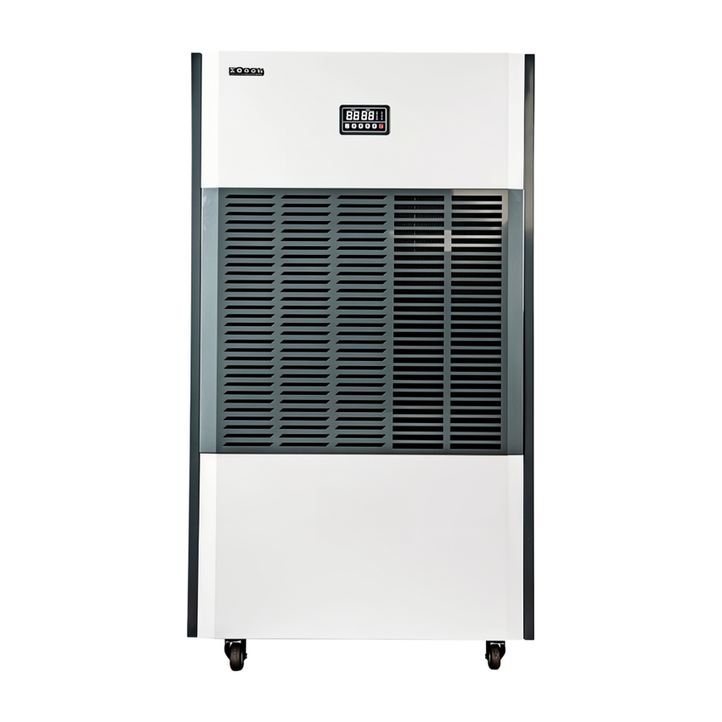
DAIHO industrial dehumidifier. Confirm model-specific capacity and drainage requirements in the quotation.
The moisture calculation should account for outdoor air entering through open doors, wet materials, floor washing and moisture released by the process. Practical issues are equally important: a correctly sized unit may still fail in use if the drain is blocked, service access is lost behind pallets or the humidity sensor is placed beside a doorway.
When an evaporative air cooler makes more sense
An evaporative cooler passes air across wet media. Water evaporation lowers the air’s dry-bulb temperature while increasing its moisture content. It works best when incoming air has a sufficiently large dry-bulb–wet-bulb temperature difference to allow effective evaporation. In already humid weather, the gap between dry-bulb and wet-bulb temperatures is smaller, so the available cooling effect is limited. An air cooler cannot dry a damp storage room.
DAIHO’s 25,000 CMH air cooler lists up to 25,000 m³/h airflow, 2.2 kW power, 15–20 L/h water consumption and a 25 L tank, with top- or down-discharge models. These figures describe the listed product variants. The quotation should confirm the model code, voltage, outlet direction, water supply, and the discharge air path.
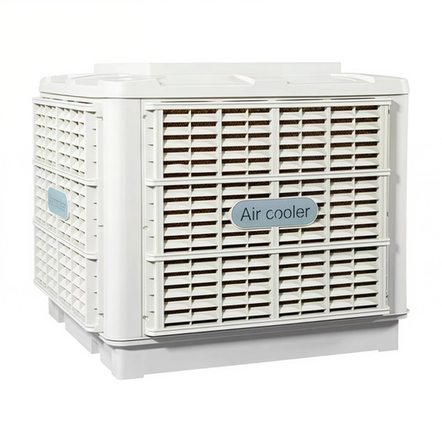
DAIHO 25000 CMH evaporative air cooler; top and down outlet versions are listed on the product page.
For a packing area, map the supply-air route across workers and ensure a clear exhaust path. A high airflow rating alone does not show the temperature or air speed at the far workstation. Confirm those conditions in the occupied zone rather than directly in front of the discharge grille.
One warehouse may need two different solutions
Consider a warehouse with a closed stockroom and an open packing bay. The stockroom stores moisture-sensitive cartons, while the packing area has high afternoon heat and a frequently open loading side. A dehumidifier may be justified in the stockroom; an evaporative cooler may suit the packing bay if the outdoor conditions and exhaust path support it. The two zones need separate performance targets and clearly defined air boundaries.
This example helps frame the decision — it does not provide a preselected equipment size. If moist air from the cooler reaches the stockroom, it can increase the load on the dehumidifier. Show the shared doors, partitions and air-transfer path on the plan before approving either quote.
What to ask suppliers before you buy
For humidity control: provide the target temperature and RH, estimated moisture sources, door-opening schedule and available condensate-drain route.
For evaporative cooling: provide the summer outdoor conditions, exhaust openings, occupied-zone layout, water source and permitted indoor humidity.
For either option: request the exact model code, voltage, operating condition behind the listed capacity, installation sketch, maintenance clearances and test locations.
For verification: confirm how the result will be checked after installation. Record the agreed measurement points and the operating conditions during the test.
The key is to compare two proposals against the same site conditions, not against rated capacities alone. A dehumidifier quote should explain moisture removal at the relevant conditions; a cooler quote should explain expected performance where people work.
The decision in one sentence
If protecting stock from moisture is the priority, choose dehumidification. For comfort in a ventilated, hot work area, evaporative cooling may fit — provided outdoor wet-bulb conditions support it. When both needs exist, specify them separately and have the supplier show how air moves between zones.
FAQs
Will an evaporative air cooler reduce warehouse humidity?
No. Direct evaporative cooling adds water vapour while it cools the air. For a warehouse with a strict humidity limit, assess the moisture impact before specifying a cooler.
Can an industrial dehumidifier also cool a warehouse?
No. A refrigerant dehumidifier removes moisture and releases waste heat into the room — it does not replace a cooling strategy.
Is evaporative cooling useful during very humid weather?
Its cooling potential is smaller when outdoor dry-bulb and wet-bulb temperatures are close. Ask for a site-specific assessment based on the summer design conditions rather than a generic temperature-drop claim.
 English
 Russian
 Arabic
 Spanish
 French
 Italian