

How to Choose an FRP Industrial Exhaust Fan for Humid or Corrosive Workshops
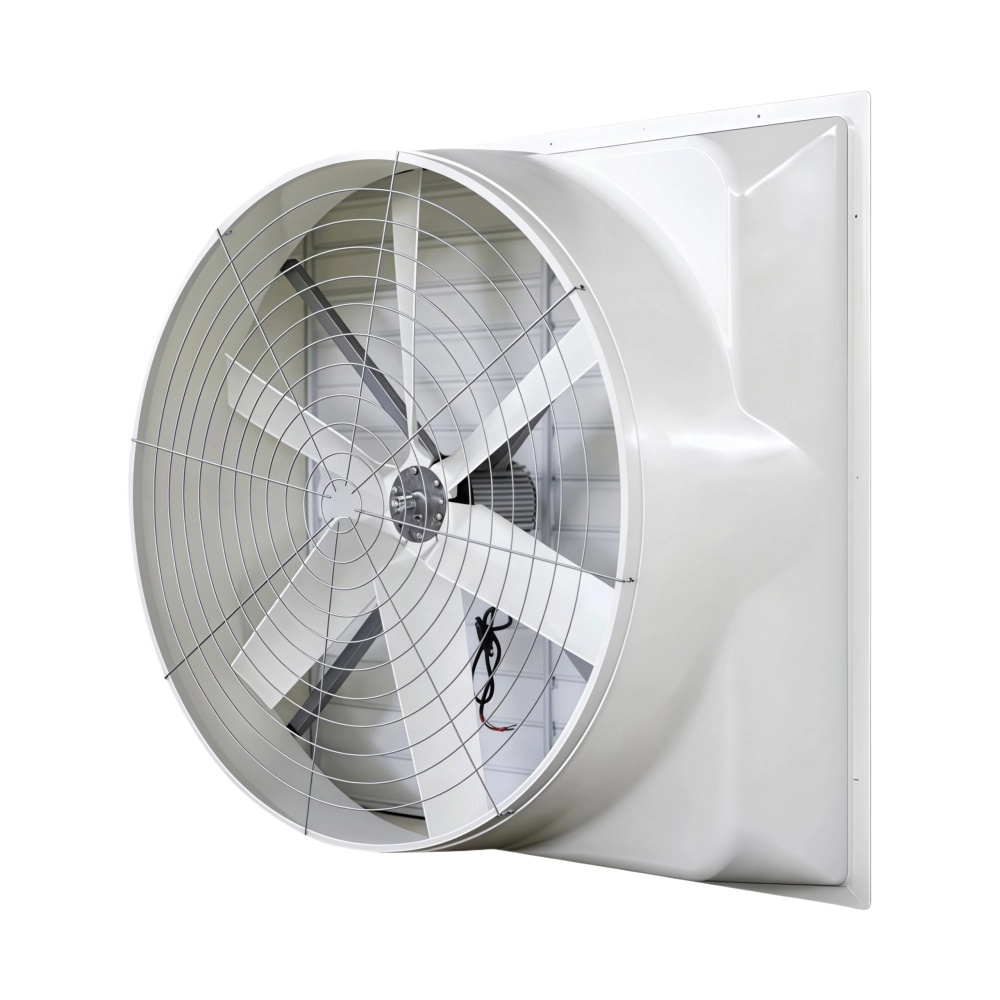
DAIHO’s supplied DH-FB sheet puts two candidate fans in the same 1460 × 1460 × 580 mm frame. Both have a 1240 mm, six-blade propeller. Here is what a buyer can see before asking for a pressure curve:
| DH-FB model | Listed airflow | Rated power | Listed noise |
|---|---|---|---|
| 1460A | 48,000 m³/h | 1.5 kW | 68 dB |
| 1460B | 45,000 m³/h | 1.1 kW | 65 dB |
Both models are worth considering. B’s lower rated power is attractive, but the sheet has not answered what either complete assembly will deliver against the building’s resistance. That question comes before the purchase order.
The first drawing should be of the workshop
Before discussing the motor, map the workshop under normal operating conditions. Put an X at the proposed fan position and circle the inlets that will actually be open during a shift. Draw an arrow from each inlet through the work area. If the shortest arrow runs from a nearby door straight to the fan, while a rack divides off the far workbench, check how that area receives replacement air. A bigger fan at the X could pull more air through the nearby door without solving the far-end problem.
On that plan I would also label the hot machines, wet work, dust-producing steps, and cleaning points. The term “corrosive” describes a potential hazard, not a specific chemical exposure. A fan that sees a mild cleaning spray once a week has a different exposure question from one exhausting a continuous chemical vapour. Name the process chemicals and cleaning agent, including concentration and temperature if the site has them documented. If these details are unknown, state that clearly in the request for quotation (RFQ). The supplier cannot check the right material against a blank.
Two airflow values, one unanswered question
Take a hypothetical duty of 42,000 m³/h once the shutter, guard and duct are in place. The listed values sit 6,000 and 3,000 m³/h above that target. These differences should not be treated as available airflow margins until the operating pressure conditions are confirmed. The same sheet lists 540 rpm and 380/220 V, 50 Hz for both models, yet the airflow at the invented workshop’s resistance remains unknown. Before approving either model, request comparable performance data and pressure information from the supplier, using the actual duct and accessory specifications.
The power and noise figures need the same restraint. Rated power is not a meter reading over a shift; the listed decibels are not a survey at the workbench. The lower entries for B are attractive enough to investigate. They do not replace an operating-point comparison or a site noise review.
FRP covers the shell question; inspect the rest
The supplier material calls its FRP/SMC housing corrosion resistant. The rooftop page describes a smooth, hand-laid FRP shell. These descriptions apply to the housing and should not be taken as confirmation that every exposed component is corrosion resistant. If a cleaner splashes the shutter and guard each Friday, their specification matters alongside the shell’s. If vapour reaches the motor side during every shift, the motor casing and cable entry matter as well. The material enquiry should identify both the chemical involved and the components it may contact.
The product sheets also disagree if someone treats them as one universal configuration. The FRP-blade sheet describes an SMC fiberglass frame and blades. Another fan sheet discusses cast aluminium and optional nylon or fiberglass blades. There is no contradiction once they are read as separate offerings. Do not combine housing and blade specifications from different product sheets without confirming that they apply to the same configuration. Request the material list attached to the exact model and option code being quoted.
Is direct drive a maintenance advantage here?
The sheets describe the motor connected directly to the fan. This design eliminates the need to inspect a belt-and-pulley assembly on this configuration. The same mechanic still needs room to isolate power, remove the guard and reach the impeller. Ask for that service route on the installer drawing; an opening can fit the equipment and still leave nowhere to work on it.
Check the opening with the actual assembly drawing
The opening error is easy to see in a different DAIHO entry. DH-55EC-A is 1720 × 1720 mm overall, while its listed hole is 1620 × 1620 mm. Overall size and hole size differ by 100 mm on that model. A separate DAIHO model illustrates why overall dimensions must be distinguished from installation opening dimensions. It would be rash to use the DH-FB-1460’s outside size as its cutout without a DH-FB fixing drawing. Put the drawing in front of the builder with the shutter, guard, cable route and weather seal marked. For roof or wash-down wall installations, also indicate the required flashing and drainage details.
The electrical entry deserves a call rather than a guess. Does “380/220 V, 50 Hz” on the family sheet mean the offered motor matches the site’s actual supply? The quote should identify the motor being shipped, its protection, the isolator and the control. Confirm these details before comparing prices for models A and B. A product-family specification is not a substitute for a complete electrical specification.
What I would send for a comparable quote
Include the marked-up workshop plan, a photograph and measurements of the opening, the airflow calculation, and the normal positions of doors and inlets. The process owner can add operating hours, contaminants and cleaning method; maintenance can add access constraints; electrical staff can state the available supply. Request equivalent documentation for both models, including installation drawings, material specifications, test conditions, pressure data, and maintenance clearances. If a shutter appears in only one offer, identify that difference before price comparison.
The online Ventilation Equipment category leads to Negative Pressure Exhaust Fans. For a roof position, there is an FRP Rooftop Exhaust Fan page. These pages help identify the product family; when contacting DAIHO, include the marked-up operating requirements and installation drawing to support a more accurate quotation through Contact DAIHO.
Before the purchase order
Three written answers should be attached: expected airflow at the installed resistance; the material and protection of each exposed part; and a drawing that fits the opening while leaving safe service access. FRP is a reasonable material to investigate in a wet or aggressive room. A complete fan choice also has to work as ventilation equipment in that particular room.
FAQs
Can I choose the lower-power DH-FB-1460B from the table alone?
No. The sheet lists 1.1 kW and 45,000 m³/h for B, but it does not settle your installed-pressure duty. Request comparable operating data for the complete options.
Is every exposed part FRP on an FRP fan?
Do not assume so. The supplied documents describe several blade materials. Confirm the exact housing, blade, shutter, guard, motor, and fastener specification against the site exposure.
What should the supplier see before quoting?
A plan of the air route, the airflow basis, opening and structural details, contaminants and cleaning method, power supply, operating schedule, and the access available for installation and service.
 English
 Russian
 Arabic
 Spanish
 French
 Italian