

Greenhouse Misting Fan Placement: Humidity and Wetting Control
A greenhouse can feel cooler after misting starts yet still have a problem: moisture settles on leaves, irrigation paths or electrical surfaces instead of evaporating into the moving air. That is why misting fan placement is a crop-management decision, not just a question of how far the fan throws its spray.
Before buying more equipment, identify where moisture is needed, how air moves through the house and how quickly surplus water can leave. The aim is controlled humidification or evaporative cooling without persistent wetting of plants and structures.
Decide Whether Misting Fits the Crop and Climate
A misting fan introduces fine water droplets into an air stream. When droplets evaporate, they absorb heat and increase the air’s moisture content. Cooling potential falls as relative humidity rises and the dry-bulb and wet-bulb temperatures move closer together. A greenhouse that is already humid may gain little temperature reduction while becoming wetter.
The operating objective matters as much as the weather. Seedlings, flowering crops and propagation areas may have different moisture requirements and tolerances for leaf wetness. Set a target based on the crop-management plan, not on a generic greenhouse humidity percentage. If the aim is only to move air through dense foliage, a circulation fan may be the more appropriate starting point.
Map the Work Area Before Choosing a Mounting Position
Walk the greenhouse with its normal plant height and bench arrangement. Check the zones beside doors, at the end of rows and under suspended equipment. Note where existing circulation fans and vents move air; a spray plume sent directly into an exhaust opening is wasted, while one aimed into a stagnant corner can leave local surfaces wet.
A practical trial starts with one defined crop zone. Keep the mist fan clear of paths and electrical installations, and direct the air stream so droplets have space to mix and evaporate before reaching sensitive surfaces. The equipment manual, local electrical protection requirements and crop characteristics should determine exact distances. Avoid using a single fixed spacing rule for every house.
Choose Hanging or Standing Equipment for the Actual Layout
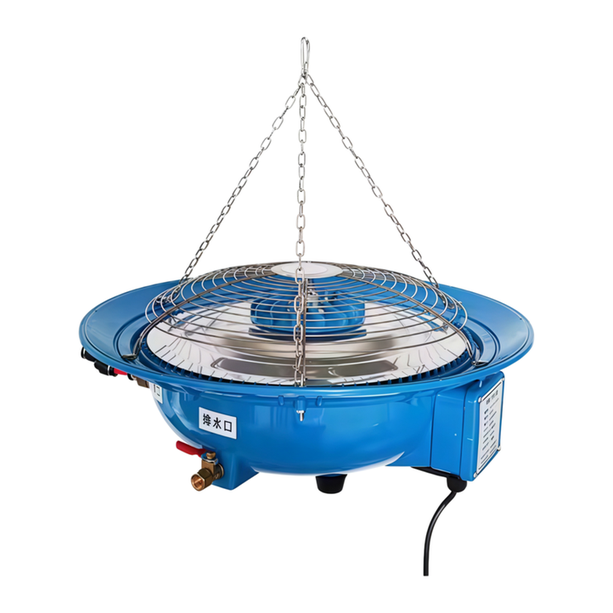
DAIHO lists a hanging-type misting fan with a centrifugal atomizing design and adjustable mist output. Its overhead installation can keep floor routes clear, provided the structure, power and water supply are suitable. The product page describes a nozzle-free centrifugal mechanism; do not treat it as a conventional nozzle-and-high-pressure-line system.
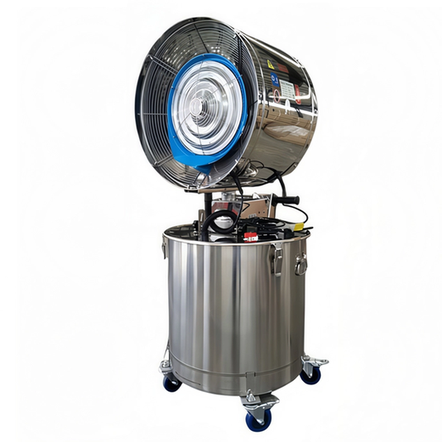
The company also offers a standing-type misting fan for applications where a floor-based unit is practical. A standing format is easier to reposition during a trial, but it needs stable floor space and protection from carts, hoses and routine cleaning.
|
Layout condition |
Hanging type |
Standing type |
|---|---|---|
|
Narrow walking routes |
Leaves floor access clear when safely mounted |
Requires protected floor space |
|
Changing crop benches |
Mounting position is less flexible |
Location can be trialed and adjusted |
|
Water and electricity |
Overhead routing needs planned service access |
Floor-level supplies need trip and splash control |
|
Inspection access |
Allow safe access to atomizer and supports |
Allow access around base and water tank |
Use Leaf Wetness as Feedback, Not an Afterthought
Run the system briefly under representative conditions and examine the actual crop zone. Are the upper leaves receiving a fine, even plume, or are large droplets collecting at leaf edges? Is condensation appearing on glazing or electrical enclosures? These observations often reveal poor placement or excessive output sooner than a single humidity reading.
Log air temperature and relative humidity at crop height, with a second sensor outside the direct mist path. Record how long the unit runs, whether ventilation is active and how long surfaces remain wet after shutoff. Calibrated sensors and consistent measurement points make comparisons meaningful. Do not rely on the sensor mounted closest to the fan as a proxy for the whole greenhouse.
Adjust the Mist and Airflow Together
If nearby foliage becomes wet but distant benches remain dry, more water is unlikely to solve the distribution problem. First reduce mist output, adjust direction or use existing circulation to carry air across the intended zone. The correct change depends on the crop’s tolerance for wetting and the greenhouse ventilation pattern.
|
Observed result |
Possible explanation |
First adjustment to assess |
|---|---|---|
|
Wet leaves near the fan |
Droplets reaching crop before evaporating |
Reduce output or redirect the stream |
|
Humid pocket in one aisle |
Limited circulation or blocked air path |
Review fan direction and existing air movement |
|
Little cooling on humid days |
Small dry-bulb/wet-bulb difference |
Reassess cooling target; avoid adding water blindly |
|
Condensation on fixtures |
Excess moisture or cold surface conditions |
Check operating schedule and ventilation |
Run a Short Trial Before Fixing the Final Position
For a newly arranged growing bench, begin with a controlled trial during a representative warm period. Keep ventilation settings unchanged for the first observation and change only one variable at a time. For example, compare two fan directions at the same mist output, then compare lower and higher output at the better location. This makes the reason for improved conditions easier to identify.
Record what happens after the misting cycle ends, not only while the plume is visible. Persistent surface water may justify a longer off-period or a different air route. In crops with strict humidity or disease-control requirements, the grower or agronomist should approve the target and operating window.
Water Quality and Cleaning Affect Performance
Centrifugal atomizing equipment still needs clean water and routine care even when it has no conventional spray nozzle. Inspect the water path, reservoir or supply connection, atomizing disc and protective grille in accordance with the supplied instructions. Deposits and contamination can impair operation; do not use unsuitable chemicals or pressure washing on electrical components.
Check what happens after the fan stops. Standing water, dripping or persistent damp surfaces call for inspection before the next cycle. Service access should be settled during the placement plan, particularly for hanging equipment above benches.
Coordinate Misting With Greenhouse Ventilation
Misting adds moisture; exhaust and make-up air remove or replace greenhouse air. Running both without coordination can waste water or create uneven conditions. During a trial, document vent positions and fan stages, then compare the same misting setting under different normal ventilation states.
ألف cooling pad and misting fan comparison helps distinguish local mist delivery from a wetted air-inlet system. Where a whole-house inlet solution is being considered, DAIHO also lists evaporative cooling pads. The choice depends on the air route and crop-management objectives; neither option guarantees a fixed temperature reduction in humid weather.
What to Confirm Before Approving the Installation
Request the exact model and power configuration, permitted mounting arrangement, water supply requirements, control method and cleaning instructions. Record the trial position, mist setting and sensor locations in the handover notes. If plant height or bench position changes during the growing cycle, recheck whether the spray reaches the intended air zone.
الأسئلة الشائعة
Can a greenhouse misting fan cool effectively in very humid weather?
Its temperature-reduction potential is limited when outdoor or indoor air is already near saturation. Measure operating conditions and assess leaf wetting rather than increasing mist output automatically.
Should the mist be directed straight at the plants?
Not as a general rule. The intention is usually to introduce fine droplets into moving air so they can evaporate; direct wetting must be evaluated against crop requirements and disease-management practices.
Is a nozzle-free fan maintenance-free?
No. Water supply, atomizing components, protective grilles and electrical connections still require inspection and cleaning under the manufacturer’s instructions.
How do I know whether the placement is working?
Compare humidity and temperature at crop height, observe leaf and surface wetness, and record the ventilation state during each trial. One humidity reading near the unit is insufficient.
استنتاج
Effective misting fan placement begins with crop needs and air movement. Choose a mounting type that suits the greenhouse, trial the spray in one defined zone and use wetting observations alongside humidity measurements. The result should be a controllable process—not simply more visible mist.
 English
 Russian
 Arabic
 Spanish
 French
 Italian