

How to Choose an Industrial Evaporative Air Cooler for a Factory
Choosing an industrial evaporative air cooler for a factory climate and production requirements, not the highest airflow rating. Check the local humidity, identify the heat producing zones, estimate the airflow those zones need, and decide how air will enter and leave the building. A suitable model then has to match the outlet arrangement, pressure requirement, water connection, electrical supply, and control method.
Evaporative cooling suits open production halls, workshops, warehouses, and semi open areas with adequate air exchange. It is less effective in very humid weather, the process cannot tolerate added moisture, or the room must remain sealed.
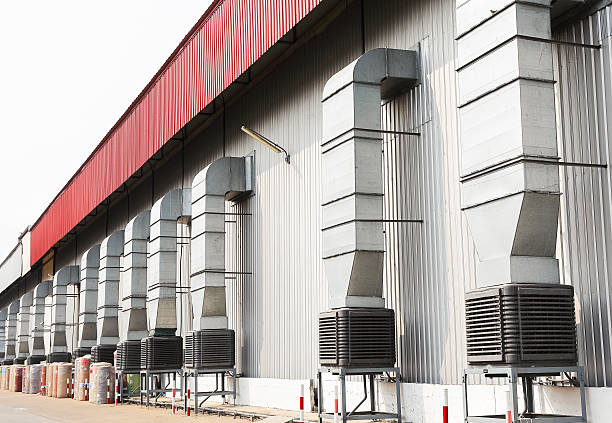
What an Industrial Evaporative Air Cooler Must Do
An evaporative air cooler draws warm through a wetted cooling medium. As water evaporates, it absorbs heat from the air, and the fan moves the cooler air into the occupied or process zone. The system combines heat transfer with air exchange rather than recirculating room air through a refrigeration condenser.
The factory must provide a clear path for air to enter and leave. Exhaust fans, louvers, doors, roof openings, or other relief paths can help discharge warm, humid air. Without that path, the cooler may create pressure and humidity without producing the intended circulation. The air cooler range should be reviewed alongside the building geometry, process contaminants, and required zones; the industrial cooling equipment category is a useful starting point for comparing configurations.
Nominal CMH does not guarantee a specific room temperature. Delivered comfort depends on entering air conditions, outlet direction, heat released by equipment, and the effectiveness of the exhaust path.
Is Evaporative Cooling Suitable for the Factory Climate?
Check both the outdoor cooling potential and the production process’s tolerance for added moisture.
Check Seasonal Temperature and Humidity
The key climate question is whether the outdoor air has enough how much evaporative cooling the outdoor air can support. When dry bulb temperature is high and wet bulb temperature is appreciably lower, the cooler can remove more sensible heat. As relative humidity rises, the available cooling margin narrows. Rainy season conditions can therefore reduce cooling effectiveness even when peak summer temperature remains high.
Screen the operating months using local dry bulb temperature and corresponding relative humidity or wet bulb data.
Check Process Moisture Limits
Paper, textiles, packaging, electronics, coatings, and stored materials have different moisture tolerances. Check the humidity limits for your materials and processes before choosing испарительные системы охлаждения. A hall with continuous exhaust is a more natural fit than a sealed room designed for precise humidity. If suitability changes by season, combine cooling with a broader ventilation strategy.
How to Size an Industrial Air Cooler for the Factory
Estimate the airflow first, then check how that air will serve the actual production zones.
Estimate Airflow from Room Volume and ACH
Start with a room volume estimate and an initial air change target:
Q = V x ACH
Here, Q is the required airflow in m³/h, V is the room volume in m³, and ACH is the selected air changes per hour. For an illustrative 20,000 m³ production hall at 8 ACH, the starting airflow is:
20,000 x 8 = 160,000 m³/h
Refine Unit Quantity and Placement
That figure is a initial design estimate, not a final model count. Divide the total by the effective airflow of the selected units, then check whether their outlets reach the occupied zones and whether the exhaust path can remove the building’s exhaust capacity. An 18,000 CMH air cooler would represent one airflow class in the comparison, but ten units at a nominal 18,000 CMH do not automatically provide uniform cooling across a long hall.
Refine the estimate for heat from furnaces, ovens, machinery, and solar gain through the roof. Account for ducts, louvers, or other restrictions when the unit is not discharging directly into the room. Use ACH to establish project scale, then use heat load and distribution checks to decide quantity and placement.
Should the Factory Use Direct Air or Ducted Delivery?
Choose the delivery method around obstructions, occupied zones, and how often the layout changes.
|
Factory Condition |
Direct Air Approach |
Ducted Approach |
|---|---|---|
|
Open hall with few barriers |
Broad discharge and spot cooling flexibility |
May add unnecessary resistance |
|
Separated zones or partitions |
Risk of uneven reach |
Better routing control |
|
Frequently changing layout |
Easy to relocate or redirect |
More fixed infrastructure |
|
Long path or several outlets |
Limited distribution control |
Check pressure and outlet losses |
Direct Air for Open Work Areas
Direct air units suit open halls where cooled air can reach a broad, unobstructed zone. Portable models support spot cooling and changing layouts, but columns, partitions, machinery, and high ceilings can leave dead zones even when the total nominal CMH appears sufficient.
Ducted Delivery for Separated Zones
Ducted delivery is useful when air must cross a barrier, reach separated areas, or follow a defined route. Ducts add static pressure, so the fan must be selected for required airflow at the system’s operating static pressure, not its free-air rating alone. Outlet size, bends, diffuser position, and leakage affect each zone. An 18,000 CMH duct air cooler can be evaluated when its outlet path matches the building.
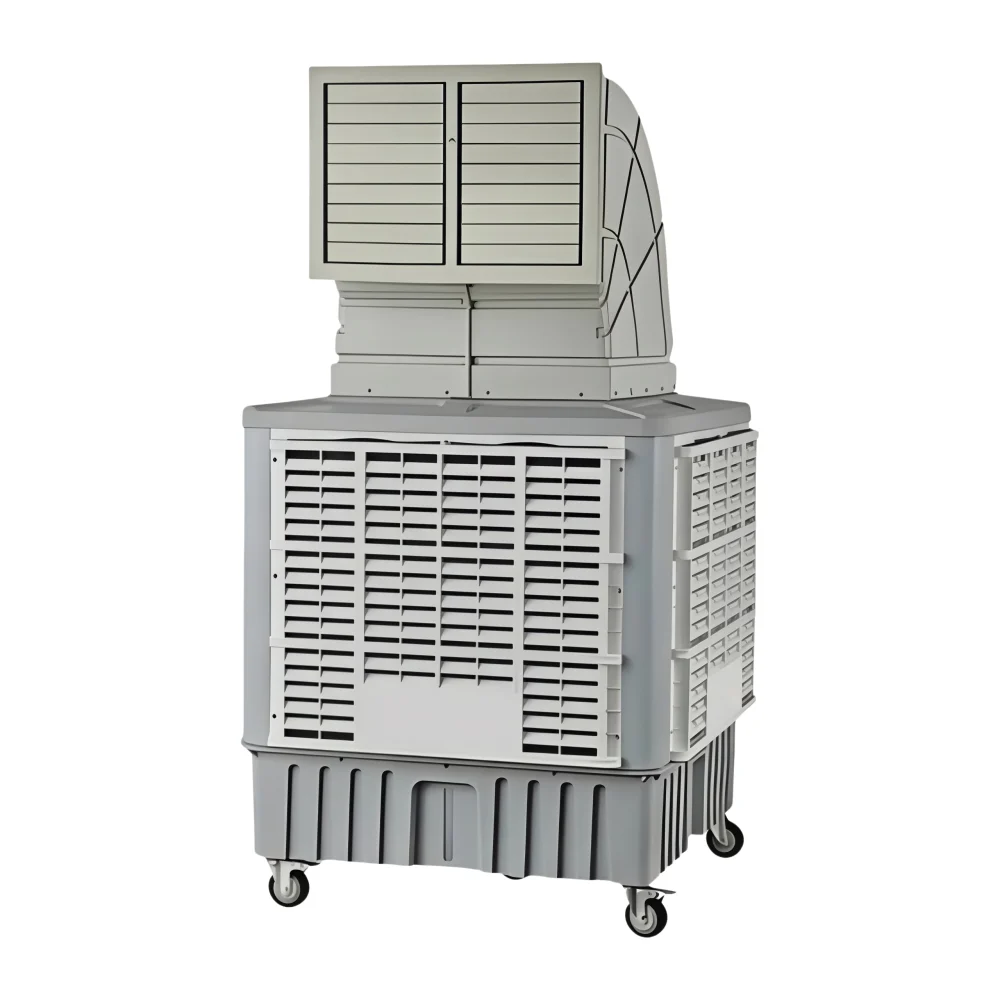
How Should Exhaust and Replacement Air Be Coordinated?
Cooling air has to move through the building instead of short circuiting from inlet to outlet. Place exhaust openings so warm air and process contaminants leave without prematurely drawing cooled air out of the building. Avoid cross drafts across sensitive workstations.
Excessive negative pressure can reduce the actual airflow delivered by a cooler when doors, louvers, or make up openings are too small. Keep general cooling airflow separate from dedicated fume or oil mist extraction where required. A layout sketch should show cooler positions, exhaust points, doors, heat sources, and intended airflow direction.
Which Specifications Matter Beyond CMH?
Compare airflow at specified operating conditions, outlet type, external static pressure for ducted models, motor power, voltage and frequency, noise, dimensions, control method, water connection, and allowable operating environment. Ask whether the quoted airflow is free air or measured at a specified static pressure. Check the number and direction of outlets, access clearances, and whether the electrical and water services are available at the proposed location. These specifications provide a more reliable basis for comparing models than nominal airflow alone.
Часто задаваемые вопросы
Can Evaporative Cooling Work in a Humid Factory?
It may provide limited benefit during humid conditions. Compare local wet bulb margin and process moisture tolerance for the actual operating season before selecting the system.
Does an Evaporative Air Cooler Need an Open Air Path?
Yes. The unit needs a path for air movement and discharge. A sealed room can accumulate humidity and restrict the exchange that makes evaporative cooling effective.
Is ACH Enough to Size a Factory Air Cooler?
ACH is an initial airflow estimate. Heat sources, climate, occupied zones, outlet reach, and exhaust capacity must refine the final quantity and placement.
When Is a Ducted Industrial Air Cooler Better?
Ducting helps when air must reach separated zones, cross barriers, or follow a controlled route, provided the fan and outlets are selected for the added resistance.
Does an Industrial Evaporative Air Cooler Need a Water Supply?
Yes. Evaporative operation needs a suitable water connection or tank arrangement. Check local water quality, supply capacity, and connection location during planning.
Turn the Selection into a Practical Model Comparison
Prepare the room volume, climate data, heat sources, target zones, air path sketch, exhaust openings, water arrangement, electrical supply, and outlet preference. Use those inputs to compare suitable DAIHO models and contact DAIHO Ventilation for a model consultation when the layout or duty point needs a closer review.
 English
 Russian
 Arabic
 Spanish
 French
 Italian