

How to Choose an Industrial Dehumidifier for a Warehouse
When selecting a warehouse dehumidifier, the humidity load should be considered first, not just the floor area. A reasonable approach is to match the dehumidifier’s rated dehumidification capacity to the actual measurable humidity sources and operating schedule of the warehouse.
Air exchange should be achieved through ventilation, sensible heat should be handled through refrigeration, and dehumidification should only be used when there is a need to independently reduce indoor humidity.
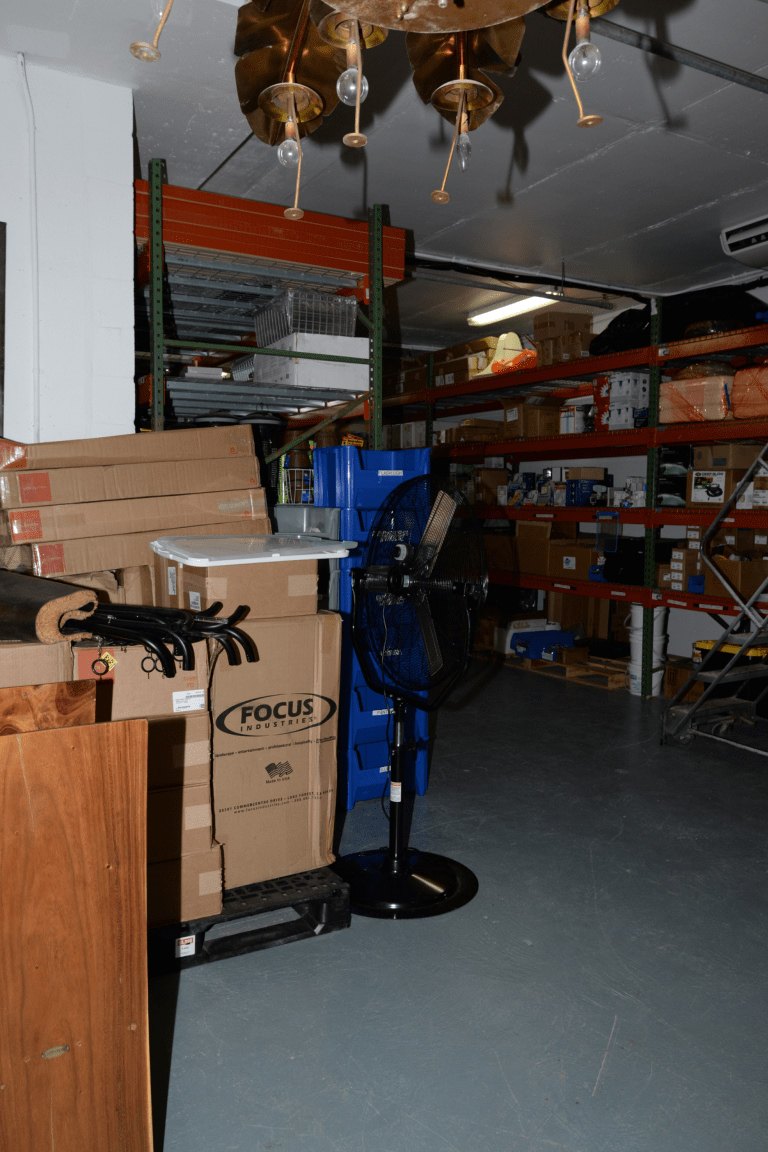
What Humidity Problem Does the Warehouse Need to Solve?
Moisture Symptoms
Start by identifying the problem you need to control: condensation on cold surfaces, damp cartons, labels that will not adhere, corrosion sensitive inventory, or unstable material moisture.
Set Zone Targets and Design Conditions
Set a target condition for each zone rather than applying one number to the whole building. A packaging room with frequent door traffic may need a different approach from a sealed storage aisle. Base each target on the stored material, packaging process, and local requirements. These design conditions provide a consistent basis for comparing equipment options beyond nominal capacity alone.
What Capacity Does a Warehouse Dehumidifier Need?
Build the Moisture Balance
Build a moisture balance on one time basis. A useful planning expression is:
M_total = M_infiltration + M_outdoor air + M_product/process + M_people
Here, each term is the water entering the zone per hour or per day. Infiltration includes humid air through doors and leakage; outdoor air covers intentional ventilation; product/process includes wet goods, washdown, or evaporation; and people usually matter most in occupied, conditioned zones. Use measured or documented inputs where possible, and state the temperature and RH assumptions used in the calculation.
Compare Capacity Ratings on the Same Basis
Capacity ratings must be compared under equivalent test conditions. A rating of 150 L/day converts arithmetically to 6.25 L/h (150 ÷ 24), but that does not make it directly equivalent to a 6.25 L/h rating unless the test temperature, inlet RH, airflow, and control condition are comparable. Treat the conversion as a common time basis, not proof of equal field performance. For higher continuous moisture loads, compare the stated range of a 15–40 L/h industrial dehumidifier with the calculated load and operating hours.
|
Warehouse Condition |
Sizing Emphasis |
Typical Decision Question |
|---|---|---|
|
Occasional condensation in one zone |
Local moisture sources and door schedule |
Can one zoned unit control the affected area? |
|
Continuous infiltration or process moisture |
Hourly moisture balance and drain capacity |
Does rated extraction cover the peak operating period? |
|
Several zones with different targets |
Separate loads and air paths |
Should capacity be divided among units or served centrally? |
Add a design margin only after the main moisture sources have been identified and estimated. Arbitrary oversizing can produce short cycles, uneven RH, unnecessary power use, and poor control at light load.
Which Dehumidifier Configuration Fits the Warehouse?
Choose a Configuration by Zone Pattern
Choose the configuration based on the airflow path and the way the warehouse operates. A portable or mobile unit can suit a changing work area, temporary stock zone, or localized moisture problems. Multiple smaller units can provide zoning when doors, racks, or walls restrict airflow across the building. A higher capacity vertical unit can be appropriate when the moisture load is continuous and the installation has a defined return and supply path.
Check Layout, Airflow, and Controls
Check clearances around pallets, forklift lanes, doors, and electrical panels. The unit should draw air representative of the affected zone and discharge treated air into the affected zone without flow directly back into the inlet directly back to its inlet. Controls should allow the operator to see the RH condition and adjust settings to meet the required conditions.
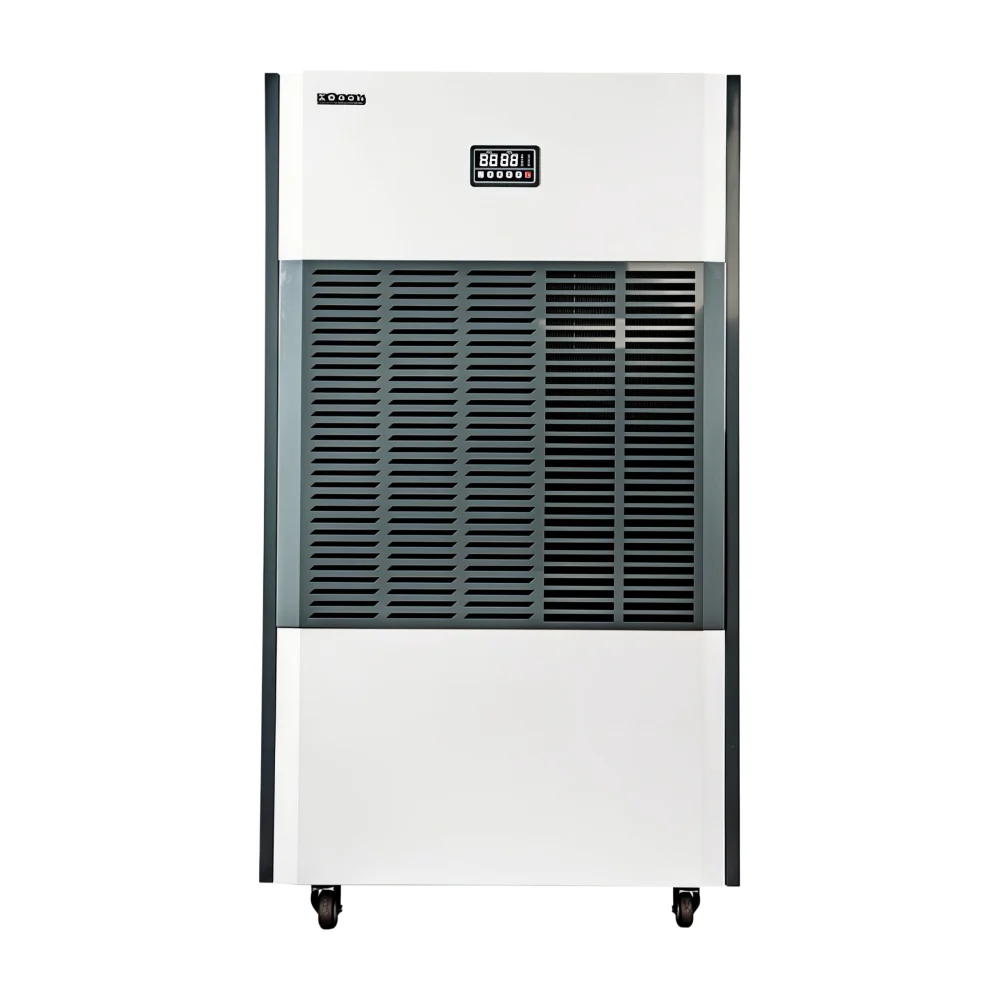
Компания DAIHO Ventilation 150 L/day commercial dehumidifier is one example of a high capacity format to evaluate, while the right choice still depends on the load, rating conditions, and layout. Compare dimensions, access, air direction, control method, and drainage alongside the extraction number.
How Should Airflow and Drainage Be Specified?
Plan Airflow through Racks and Zones
Effective dehumidification requires humid air reaches the moisture-removal section and treated air returned to the target zone. Check the manufacturer’s airflow direction, required clearances, and whether racks or partitions create stagnant pockets. In a long warehouse, consider whether one unit can circulate through the full volume or whether separate zones are more practical.
Specify Condensate Drainage and Utilities
Condensate handling is equally important. Confirm whether the unit uses a tank, continuous gravity drain, or an external pump. Trace the hose to a suitable floor drain, allowing for the required slope or pump lift, and protect the route from traffic. Record electrical voltage, frequency, breaker requirements, sound expectations, and the space needed to access controls and drain connections. These installation requirements can determine whether a nominally suitable unit is practical in the building.
When Is Dehumidification Better Than Ventilation or Cooling?
Ventilation exchanges indoor air with outdoor air. This is beneficial when outdoor air is relatively dry; however, in humid weather, it can increase moisture load.
While cooling can lower dry-bulb temperature and may cause some condensation, if cooling is the only measure, it can lead to excessively high relative humidity in warehouses when the warehouse needs humidity control without substantial temperature reduction.
Combine Controls by Duty
Dehumidification is the direct choice when the target RH must be maintained independently of outdoor humidity or sensible cooling demand. Many warehouses need a combination: controlled outdoor air for air quality, cooling for heat, and dehumidification for moisture. Define each system’s role before selecting equipment, then avoid counting the same moisture removal effect twice.
What Should Buyers Verify Before Ordering a Warehouse Dehumidifier?
Compare Rated Performance
Ask every supplier to provide the rated moisture removal capacity at specified temperature and RH, together with airflow, operating range, controls, drain method, electrical supply, dimensions, sound data, and installation clearances. Request the test basis behind L/day or L/h values and identify whether the rating is nominal, maximum, or tied to a particular inlet condition.
Prepare the Warehouse Design Basis
Provide the supplier with the warehouse volume, affected zones, target RH, moisture balance assumptions, door schedule, outdoor air condition, drainage route, operating hours, and a simple layout. This information makes different offers comparable and identify missing information before placing an order.
Часто задаваемые вопросы
Q: Is a Larger Dehumidifier Always Better for a Warehouse?
No. Capacity should match the moisture load and control range. Oversizing can create short cycles, uneven humidity, and unnecessary energy use, especially when the warehouse load changes during the day.
Q: Can I Compare L/Day and L/H Ratings Directly?
Convert the time basis first, but compare only when temperature, RH, airflow, and test conditions also match. The arithmetic conversion alone does not establish equal real world moisture removal.
Q: Will More Ventilation Remove Warehouse Humidity?
Only when incoming air is drier than indoor air. During humid weather, open doors and outdoor air systems can add moisture, so check the outdoor condition before treating ventilation as a dehumidification method.
Q: What Relative Humidity Target Should a Warehouse Use?
Set the target from the stored materials, packaging, process, and local requirements. A universal RH value does not suit every warehouse, and different zones may need different setpoints.
Prepare a Warehouse Dehumidifier Model Review
A suitable warehouse dehumidifier must match both the moisture load and the operating conditions. If you need help comparing options, talk to us about your warehouse. Those details let the equipment shortlist follow the warehouse’s actual moisture load.
 English
 Russian
 Arabic
 Spanish
 French
 Italian