

How to Size an Industrial Dehumidifier
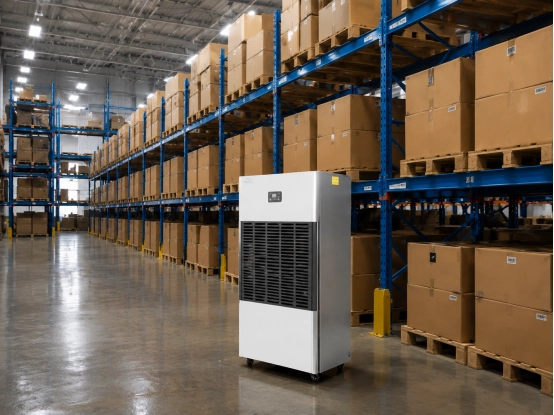
Sizing an industrial dehumidifier looks simple until the building conditions are evaluated. A warehouse may be listed as 700 m², but this information alone says little about ceiling height, loading doors, wet processes, or the humidity level that must be maintained.
An undersized unit runs continuously while damp areas remain behind racks or near exterior walls. Oversizing can bring unnecessary cost and result in unstable humidity control. Equipment selection should start with the actual space conditions, not only the product catalog.
What Information Do You Need Before Sizing an Industrial Dehumidifier?
Useful sizing data comes from floor plans, site observations, and several days of temperature and humidity readings. Moisture sources that appear only during cleaning or loading activities should also be included.
Space Dimensions
Record the length, width, and average clear height. Do not rely on floor area alone. A 600 m² warehouse with a 4 m ceiling contains 2,400 m³ of air. Under an 8 m roof, the air volume doubles.
Partitions and high storage racks affect circulation. One volume calculation can mislead when airflow is restricted.
Current and Target Humidity
Measure relative humidity at several points and during different operating periods. Readings near doors, cold walls, and process equipment often vary.
The target must be realistic. General storage may tolerate 55–60% RH, while electronics or moisture sensitive materials may need tighter control. Maintaining 40% RH requires a different dehumidification load than reducing a room from 75% to 60% RH.
Sources of Moisture
Moisture enters through outside air, wet materials, washdown, people, steam, and the building envelope. Loading doors are a common source of moisture infiltration. A door opened every half hour can add a significant summer moisture load.
Damp basement walls or floors may create a continuous load, even in a sealed room.
How Do You Calculate the Volume of the Industrial Space?
Room volume is calculated as:
Length × Width × Height
A 700 m² warehouse with a 6 m average height has a volume of 4,200 m³. This matters because the dehumidifier must dry the air within the full volume.
Divide irregular spaces into simple zones. Separate rooms may need separate calculations where doors remain closed or racks block airflow.
Volume is only a starting point. It shows the amount of air in the space, not the actual amount of moisture that must be removed.
How Much Moisture Must the Dehumidifier Remove?
Required capacity comes from two loads: moisture already in the space and moisture that keeps entering. In most facilities, the ongoing load decides the equipment size.
Estimate the Initial Moisture Load
The initial load is the water removed while the room moves from its current condition to the target. It depends on air volume, temperature, current RH, and target RH.
The calculation is based on actual moisture content rather than RH alone. Warm air at 70% RH holds more water than cool air at the same RH. Psychrometric data is normally used here.
For seasonal drying, pull down time matters. In an operating factory, the daily incoming load usually matters more.
Estimate the Ongoing Moisture Load
Ongoing moisture comes from infiltration, ventilation, door openings, products, cleaning, people, and production. This is where area based sizing often fails.
A food processing room may be small but carry a heavy load from washing and warm product. A large archive store may be easier because it is sealed and rarely opened.
Check ventilation rates, door schedules, floor washing, and wet goods entering from outside. These observations are more useful than a rough square meter rule.
How Should You Interpret Dehumidifier Capacity Ratings?
Catalog ratings are useful only when test conditions behind them are clearly understood. Capacity, airflow, and coverage area describe different aspects of performance.
Liters per Hour and Liters per Day
A rating of 20 L/h industrial dehumidifier suggests a theoretical 480 L/day if the unit runs continuously at the stated condition. It does not guarantee 480 liters of moisture removal per day under actual site conditions.
Water removal falls as temperature and humidity drop. A unit rated in warm, humid air may remove significantly less moisture in a cool warehouse environment. Check the rating condition before comparing models.
Airflow and Air Circulation
Airflow, shown in m³/h, indicates how quickly the unit moves air. Adequate circulation helps prevent local wet zones.
High capacity with poor distribution is common. Dry air may circulate near the machine while corners behind stored goods remain damp. Ducting systems or multiple units may be required to improve air distribution.
Coverage Area
Coverage area is a screening guide, not a design value. It assumes a certain ceiling height, moisture load, temperature, and building condition.
A unit described for 600–800 m² may work in one warehouse and fail in another of the same size. Differences in door activity and air leakage often explain this variation.
Which Real World Factors Should You Use to Adjust the Calculated Capacity?
Adjust capacity for actual site conditions. Frequent door opening, poor sealing, low temperature, wet processes, and strict RH targets all increase the required dehumidification load.
Low temperature operation deserves attention. Refrigerant dehumidifiers lose performance as coil temperature approaches freezing, and defrost cycles reduce effective capacity. In cold rooms, a desiccant unit may be the better choice even if its headline rating looks lower.
A reasonable capacity margin is recommended, but excessive oversizing should be avoided. A unit selected far above the real load may cost more and still leave airflow problems unsolved.
Should You Choose One Large Dehumidifier or Multiple Smaller Units?
One large unit suits an open building with clear airflow paths. Maintenance is simpler.
Multiple units make more sense in divided spaces, long warehouses, or buildings with isolated moisture sources. They also provide partial backup capability if one unit requires maintenance.
Building layout often matters as much as total liters per day when selecting a dehumidifier. A single machine cannot dry air that cannot reach it.
How Can You Confirm That the Selected Dehumidifier Is Large Enough?
Check rated capacity at the expected operating temperature and RH, rather than relying only on the manufacturer’s standard test conditions. Confirm airflow, electrical supply, drainage, defrost behavior, and continuous operation limits.
Dry air must travel through the occupied zone and return without short circuiting near the unit.
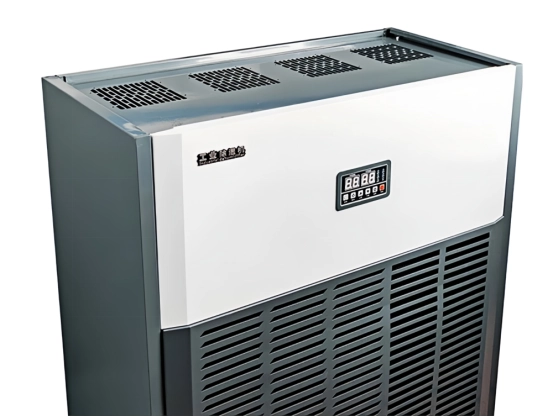
During commissioning, log temperature, RH, run time, and collected water. Stable RH with sufficient capacity reserve indicates that the system is properly sized. Continuous operation with rising humidity is not. A high capacity industrial dehumidifier may be suitable for large warehouses and production areas with continuous moisture loads.
Frequently Asked Questions About Industrial Dehumidifier Sizing
Q: Can I Size an Industrial Dehumidifier by Square Meters Alone?
No. Floor area is useful for screening, but ceiling height, temperature, target RH, air exchange, moisture generation, and leakage are needed for a sound selection.
Q: Is a Higher L/Day Rating Always Better?
Not necessarily. Higher capacity provides reserve, but it may also increase purchase cost, electrical demand, and cycling. The correct rating is the one that matches the actual moisture load.
Q: How Much Extra Capacity Should I Allow?
There is no fixed percentage for every site. A sealed store may need little margin. A warehouse with busy doors and seasonal humidity swings needs more. The margin should reflect uncertainty, not replace measurement.
Conclusion: Choose Capacity Based on Moisture Load, Not Area Alone
Industrial dehumidifier sizing is about finding where water comes from and how quickly it enters. Measure the space, record actual conditions, define the target, and examine daily operation. Floor area is only the beginning.
For large scale facilities or high-humidity environments, provide site operating conditions to DAIHO Ventilation to receive reliable dehumidifier recommendations.
 English
  Russian
  Arabic
  Spanish
  French
  Italian