

How Much Airflow Does an Industrial Air Cooler Need? A Practical CMH Guide
Choosing an industrial air cooler by floor area alone often leads to poor results. A 100 m² workshop with a 3 m ceiling contains 300 m³ of air, while the same floor area with a 6 m ceiling contains 600 m³. The second space generally needs more airflow even though the floor area is identical.
A useful estimate begins with room volume. It also uses air changes per hour. Heat sources, open doors, humidity levels, and airflow obstructions can all affect the final airflow requirement. These factors should be evaluated before selecting an air cooler.
What Does CMH Mean in an Industrial Air Cooler?
CMH means cubic meters per hour. It indicates the volume of air an air cooler can move in one hour under rated conditions. A 5,500 CMH industrial air cooler has a nominal airflow capacity of 5,500 m³/h.
CMH is not the same as cooling capacity. It does not show how many degrees the air temperature will drop. Actual performance depends on several factors, including temperature, humidity, cooling pad condition, fan pressure, outlet design, and equipment placement.
For equipment comparison, CMH should be treated as an airflow rating rather than a complete measure of cooling performance.
How Do You Calculate the Required Airflow?
The easiest sizing method uses room volume. It also needs a target air change rate.
Step 1: Calculate Room Volume
For a workshop measuring 8 m long, 5 m wide and 3 m high:
8 × 5 × 3 = 120 m³
Ceiling height is a critical factor in airflow calculation. A high bay warehouse contains much more air than a standard workshop with the same floor area.
Spot cooling works in another way. The entire building volume may not always require cooling. Workers stay in the lower part of the building. Airflow can be directed toward that occupied zone more effectively.
Step 2: Select a Target Air Change Rate
Air changes per hour, or ACH, describe how many times the air volume of a space is supplied or exchanged in one hour.
The right value depends on the application. A lightly occupied assembly area needs less air movement. A workshop with welding equipment needs more. Motors or ovens can further increase the requirement.
Calculate several ACH scenarios during the initial design stage, such as 10, 15, and 20 ACH. These values give design estimates. They are not fixed rules for all industrial sites.
Step 3: Convert Room Volume into CMH
Use this formula:
Required CMH = Room volume × Target ACH
For the 120 m³ workshop:
At 10 ACH: 1,200 CMH
This is a starting point. Final airflow may need to be higher because real buildings contain machinery, racks, partitions and open doors.
Which Factors Can Increase the Airflow Requirement?
Several site conditions can increase the required airflow or reduce the useful air reaching workers.
Heat producing equipment: Motors, compressors, furnaces and production lines add heat continuously.
High ceilings: A larger air volume may require more circulation.
Obstructions: Racks, machinery and partitions can shorten the effective blowing distance.
High humidity: Direct evaporative cooling becomes less effective as outdoor humidity increases.
An evaporative cooler also needs an outlet path for warm, moisture laden air. It should not be operated in a completely sealed room in the same way as a refrigerated air-conditioning system.
For irregular layouts, multiple smaller coolers may provide better air distribution than one large unit because each can be directed toward a separate work area.
How Much CMH Is Needed for Different Space Sizes?
The table below shows calculation examples, not fixed product recommendations.
| Application Area | Dimensions | Volume | Example ACH | Calculated Airflow |
| Small workstation | 5 × 4 × 3 m | 60 m³ | 15 | 900 CMH |
| Small workshop | 8 × 5 × 3 m | 120 m³ | 20 | 2,400 CMH |
| Medium work area | 10 × 8 × 4 m | 320 m³ | 20 | 6,400 CMH |
| High bay work zone | 12 × 10 × 6 m | 720 m³ | 15 | 10,800 CMH |
A safety margin may be needed for long air paths, dirty cooling pads, obstacles and air loss through doors. However, equipment position and outlet direction can have a greater impact than simply increasing the CMH rating.
Is a Higher CMH Rating Always Better?
No. An oversized cooler can create excessive drafts, unnecessary noise and higher equipment cost. It may also move air above or around the occupied zone without improving comfort.
An undersized unit can produce weak circulation, limited airflow reach, and persistent hot spots.
Correct selection balances rated airflow with blowing distance, outlet direction, noise, power consumption, room geometry and cooler position. A smaller unit placed close to the work area may perform better than a larger cooler located behind machinery.
How Do You Match the Calculation to an Actual Air Cooler?
Start with the calculated CMH range, then compare the cooler’s effective area, blowing distance, power input, water capacity and noise rating.
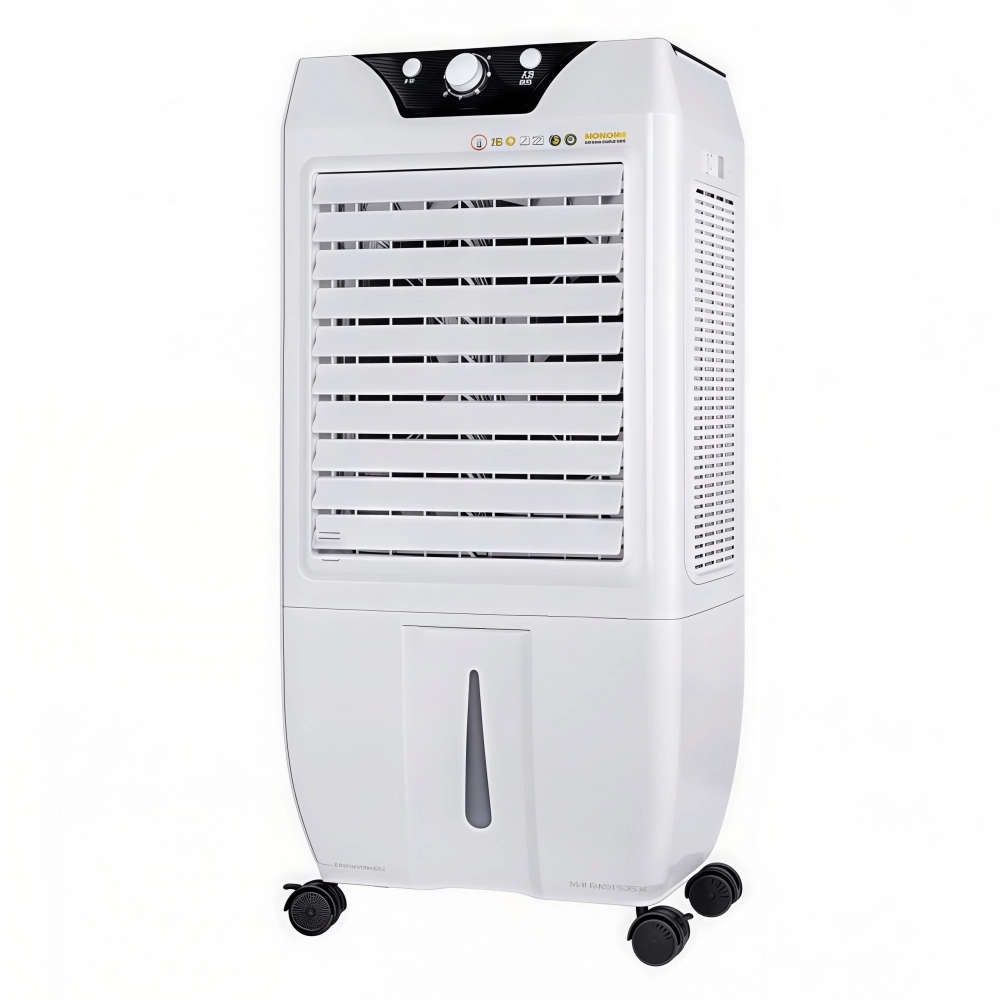
For example, DAIHO Ventilation’s KT-5500 models are rated at 5,500 m³/h, with a listed effective area of 20–35 m² and a blowing distance of 6–8 m. This type of portable industrial air cooler may suit a small workshop or defined work zone when its discharge can reach the occupied area.
The same unit will not deliver identical cooling performance in every 30 m² space. A repair workshop with moderate heat load represents one application. A boiler room with high process load is another. Ceiling height still needs checking. Humidity levels matter. Heat sources must be known. Exhaust openings affect results.
Multiple units can improve airflow coverage in larger or irregular spaces.
What Should You Check Before Buying?
Before selecting an industrial air cooler, evaluate the following factors:
- Room length, width and clear height
- Main heat sources and worker locations
- Door and window openings
- Ambient temperature and humidity
- Required blowing distance
- Electrical and water supply
- Acceptable noise level
- Portable or fixed installation
Also decide whether the objective is spot cooling, general air movement or whole space temperature control. These are different design tasks.
Frequently Asked Questions
Q: Is 5,500 CMH Enough for a Small Workshop?
It may be suitable for a small work zone, but floor area alone cannot confirm the selection. Ceiling height needs checking. Heat load is important. Humidity levels matter. Blowing distance should be considered. Ventilation openings affect the result.
Q: How Do I Convert CFM to CMH?
Multiply CFM by approximately 1.70. For example, 3,000 CFM is about 5,100 CMH.
Q: Can One Industrial Air Cooler Cool an Entire Warehouse?
A portable unit works best for spot cooling. It can handle a defined zone. Large warehouses usually require several units. A full ventilation and cooling system may be necessary.
Q: Does Higher Airflow Mean a Larger Temperature Drop?
The answer is not always yes. Higher airflow improves air movement. Temperature reduction depends on outdoor temperature. Humidity plays a big role. Evaporation conditions affect it too.
Choose Airflow Based on Volume and Application
The practical starting point for industrial air cooler sizing is room volume multiplied by a suitable air change target. This provides a useful CMH range, not a final equipment selection.
Heat gain, humidity, building openings, air distribution and blowing distance all affect real performance. The best unit is not always the model with the highest airflow rating. It is the one that delivers enough air to the correct work area under actual operating conditions.
 English
  Russian
  Arabic
  Spanish
  French
  Italian