

Portable or Fixed Warehouse Evaporative Cooling?
The discharge is cool enough to make a fine sales demonstration. Walk past the second rack end and the packer is still uncomfortable. Keep both readings. One confirms that the cooler operates; the other says its air has not reached the job.
Begin the portable-or-fixed choice with that gap. Warehouse evaporative cooling on wheels can follow the crew; permanent supply suits a bench that stays. If the receiving door changes state during the day, draw it twice. Open and shut are two different airflow plans.
Define the Goal for Warehouse Evaporative Cooling
On the plan, mark long-stay work rather than every place somebody crosses. Add a time beside it. Loading may own the heat problem in the morning and inspection after lunch; one shaded rectangle labelled “warehouse” hides the handover.
Take another pencil and trace the exit. Whatever the cooler brings indoors – outside air plus evaporated water – the building must let out again at a comparable rate. A door is not a relief opening during the hours when operations keep it shut. The DAIHO Ventilation industrial ventilation and factory cooling solution draws supply, circulation, and exhaust together. Leave off the last leg and there is no route yet.
When a Portable Industrial Evaporative Air Cooler Fits
If tomorrow’s hot spot will move, wheels have a real job. An eight-week packing line or temporary maintenance crew can use a portable industrial evaporative air cooler without making a claim on the building after leaving. Before any wall is cut, the same machine can test whether the proposed position reaches the workers.
Run that trial for a normal shift. Measure at the people, after conditions settle, rather than enjoying the first cold reading at the outlet. Watch what operations do with the unit too. If its best position steals a forklift turn, it will be moved. If the cable crosses traffic or the tank has no owner, “portable” soon means “parked somewhere harmless.”
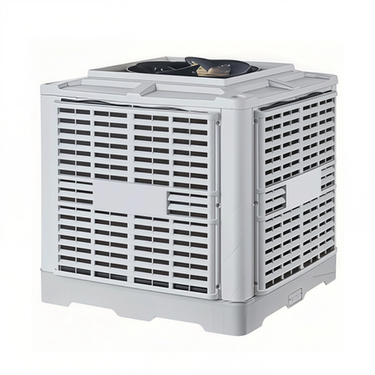
The DAIHO Ventilation page for the 30,000 CMH portable industrial air cooler specifies 3.0 kW, eight axial-fan blades, and a 60 L tank. The rack ahead, today’s humidity, and the closed door behind are absent from that data. A full-shift trial provides the missing site information.
When a Fixed Factory Cooling System Is the Better Choice
Six bolted-down benches do not need a new cooling position each morning. In that setting, moving and reconnecting equipment is just labour wearing a “flexible” label. A fixed factory cooling system can keep the aisle clear and give water, power, drainage, controls, and outlets a protected home.
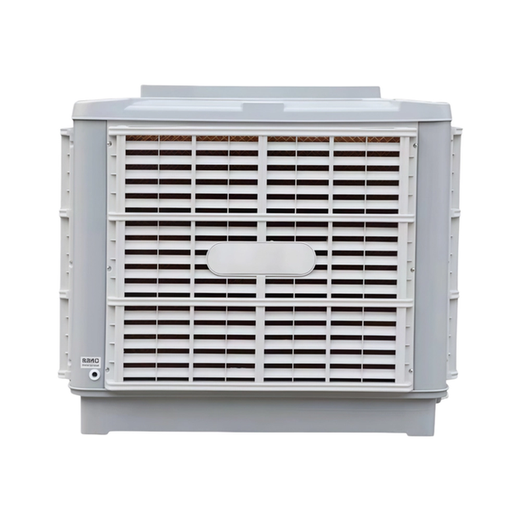
Make the permanent proposal survive an untidy review. The pad and pump need a service route; elbows take pressure; an intake may face dust or rain; the roof may refuse the opening. DAIHO Ventilation offers its fixed 18,000 CMH evaporative air cooler with top, down, and side discharge. Listed 1.1 kW versions include manual single-speed and LCD multi-speed control. Let the work zone choose among them, rather than the easiest opening for the installer.
Compare Portable and Fixed Industrial Evaporative Air Coolers
Change points towards portable equipment; repetition points towards fixed supply. That rule applies by zone, not by postal address. The daily line can have permanent outlets while one mobile cooler earns its keep at stocktaking, during shutdown work, or beside a seasonal table.
| Site reality | Portable arrangement | Fixed arrangement |
|---|---|---|
| The job moves | Follows the crew | May point at yesterday’s layout |
| Traffic is tight | Takes floor and cable space | Leaves the aisle open |
| Services | Tank or movable connections | Protected permanent connections |
| Daily work | Position, fill, drain, park | Start, inspect, scheduled service |
| Racks may change | Easy to move again | Expensive to redirect |
The lower quotation may purchase the busier routine. Count the fills, cleaning, parking places, cables, and shift checks for several mobile machines. Against that, put today’s construction cost and tomorrow’s possible rack move for a fixed system. The industrial cooling equipment range only becomes comparable after those hours and disruptions join the price.
Plan Airflow and Humidity Around Warehouse Evaporative Cooling
Before equipment enters the conversation, check how much evaporation the climate will permit. Hot air with spare moisture capacity can cool appreciably as water enters it. Near saturation, that capacity is small and the two thermometer readings sit close together. No water setting can prise them apart. Keep actual summer readings beside the airflow figure.
Trace supply to relief on paper, then take the drawing for a walk. Its line passes effortlessly through wrapped pallets, partitions, fire doors, and parked trucks. Real air has to go around. Once conditions settle, take the thermometer away from the grille and over to the job; that is where the decision gets judged.
Select a Factory Cooling System That Can Be Maintained
For a mobile unit, service stays near the floor with its tank, castors, cable, pump, and pads. Mount the equipment and the technician may instead need an outside panel, intake, drain, duct, ladder, or platform. Labour has moved, not disappeared.
Scale works by inches, not announcements. Pad passages tighten and performance drifts until a once-ordinary afternoon feels difficult. Give wetting checks, circuit cleaning, drainage, and media removal an owner. That owner should see the proposed location before anyone signs the order.
For a site comparison, send our team the warehouse plan and shift details. Mess is useful evidence here. Mark closed doors and rack ends, along with heat sources, traffic, workstations, water access, clear height, and summer humidity. The proposed air route must cope with the working warehouse, not its cleaned-up outline.
Domande frequenti
Q: Can one portable evaporative cooler serve a whole warehouse?
A: One unit can sometimes serve a small, open space with reliable relief. In a tall or divided building, racks and partitions create separate zones in practice. Measure the next zone rather than extending the outlet reading to it by assumption.
Q: Does fixed evaporative cooling need exhaust openings?
A: Yes, because the cooler keeps adding outdoor air. Give that incoming volume somewhere dependable to displace indoor air, whether through a door, louver, roof outlet, mechanical exhaust, or a combination. An unreliable exit leaves moisture behind and cooling fades as the shift continues.
Q: Which option suits a warehouse with changing work areas?
A: Begin with a mobile trial if the crew, bench, or hot spot keeps changing. Build a permanent route only when the occupied zone and the path from supply to relief have become repeatable parts of the shift.
 English
 Russian
 Arabic
 Spanish
 French
 Italian