

Industrial Spot Cooling Layout: Airflow and Heat Exhaust
A spot cooler can blow cold air while an operator standing two metres away still feels the heat. Perhaps the outlet points across an aisle, a machine blocks the stream, or the cooler draws in air it has just heated. Moving the unit a short distance may solve the problem.
A workable industrial spot cooling layout starts at the operator’s position. Trace the intake, the cold stream toward the task, and the condenser’s heat discharge. Each needs room to work. The examples below cover inspection tables, production equipment and temporary maintenance stations using compressor-based spot air conditioners.
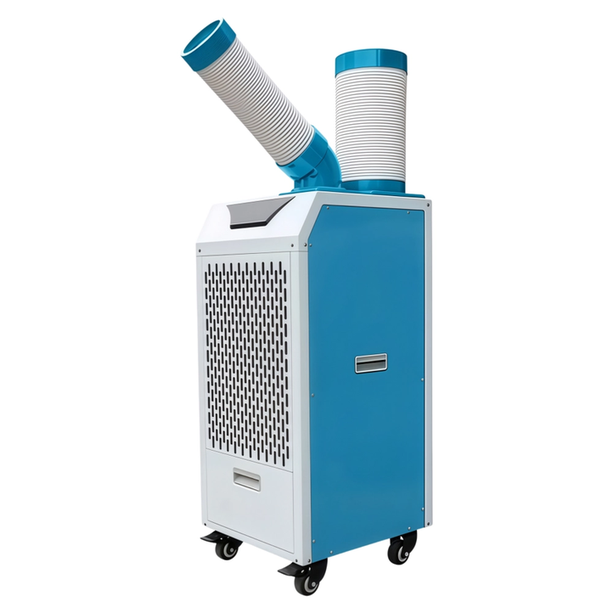
DAIHO portable single-outlet spot cooler, shown with adjustable delivery duct and mobile chassis.
Identify the Air Paths Before Choosing a Position
Air Entering the Unit
Start at the intake grille. A cooler parked against cartons or a machine enclosure may have room for its wheels but too little room to draw air. Follow the model’s specified clearance. Avoid positions where cutting dust or washdown water could affect the filter or electrical components, and leave access for cleaning.
Cold Air Reaching the Workstation
Stand at the operator’s usual position and look toward the proposed outlet. Will a guard, partition or open cabinet door block the air? Aim the nozzle at the working position, not the centre of the bench. Where the task involves bending or turning, allow for those movements instead of targeting one fixed spot.
Heat Leaving the Cooler
A refrigerated spot cooler releases heat through its condenser, including heat removed from the cold-air stream. In a narrow bay, the warm discharge can collect behind the cabinet and return to the intake. DAIHO describes a rear exhaust on its dual-duct model; the permitted exhaust arrangement depends on the unit supplied.
Match the Number of Outlets to the Work
A repair bench may need only one well-directed stream. DAIHO’s portable single-duct spot cooler is an option for focused cooling. Place it where the air can reach the worker and the filter and condensate container remain accessible. Identify the actual cold-air outlet on the supplied unit; visible hoses may serve different functions.
For two nearby operators, a DAIHO double-duct spot air conditioner offers separately directed outlets. Its product page includes the DH-A-27B, rated at 2.7 kW refrigeration capacity and 400 m³/h airflow. Those figures describe the unit, not how much useful air will reach each worker. Check the actual outlet arrangement before choosing the layout.
Il DAIHO triple-duct spot cooler can direct air toward three adjacent positions. Sketch their locations first. If machine frames block the streams or the stations are far apart, several smaller cooling points may be easier to arrange.
Place the Cooler Without Creating a New Problem
Place the cooler beside the task, outside pedestrian and vehicle routes. Avoid uneven or wet floors and protect the power cable. The operator must be able to reach the bench and open machine guards without shifting the cooler. Leave room to service the unit, too.
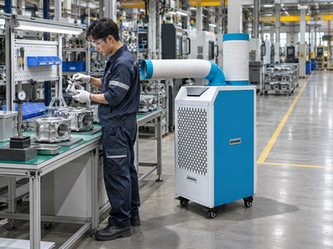
Illustrative industrial workstation layout with a portable spot cooler positioned beside the operator (AI-generated from DAIHO product reference).
Workstation Next to a Hot Machine
At an inspection table beside a heated line, a nozzle aimed into the rising hot plume may lose much of its useful cold stream. Direct air across the inspector’s working area without interfering with the machine. Keep the required extraction for fumes or hazardous dust; comfort cooling cannot control those emissions.
Several Operators Along One Assembly Line
Mark where people spend most of their shift. One worker may stay at a fixture while another moves between stations. Multi-outlet cooling suits nearby fixed positions, but a tall machine panel can block the stream. Compare the routes before extending ducts or selecting more capacity.
Temporary Maintenance Area
During a shutdown or repair, the work zone may move several times. Reposition the wheeled cooler with the crew, keeping its intake clear and its heat discharge suitable at each stop. Long hoses and electrical leads across a busy passage introduce avoidable hazards.
Plan the Hot Air Exhaust Route
A cold outlet can feel effective even when the unit’s hot discharge is poorly placed. Establish whether the model rejects heat into a ventilated space or supports an approved exhaust connection. If ducting is permitted, follow the specified diameter, length, bends and resistance. An improvised hose may restrict condenser airflow or trigger a protective shutdown.
Follow the warm discharge after the system has been running for a while. It should not be aimed at the operator, another cooler’s intake, or a doorway supplying fresh air. In a small enclosed room, the rejected heat may accumulate faster than the room can remove it. That calls for a separate ventilation arrangement or a different cooling layout, even when the nozzle air initially feels cold.
Check Condensate and the Electrical Supply
Refrigerated cooling also removes moisture from the air. DAIHO lists a collection tank and an optional continuous drain arrangement for some of its portable products. Identify which arrangement the selected model uses before choosing the final position. A tank should be accessible for emptying; a drain hose needs a route that avoids kinks, pedestrian traffic and water near electrical equipment.
The electrical connection deserves the same early attention. Compare the site voltage and frequency with the nameplate, provide the protection required for the installation, and keep the lead clear of wheels and sharp metal edges. Do not confuse cooling capacity with electricity consumption: DAIHO publishes 2.7 kW refrigeration capacity and 1,050 W input power for the DH-A-27B. Actual electrical requirements must follow the unit supplied.
Test the Layout During a Typical Shift
Test with production running and doors in their usual state. Let the operator work normally and watch whether the cold stream still reaches the occupied area as tasks change. After the unit has run for a while, inspect the hot discharge, intake and condensate handling. An idle-machine test can miss these problems.
Record the nozzle position and take temperature readings at the workstation and a consistent reference location if suitable instruments are available. If the air misses the person, adjust the outlet or move the unit and test again. If the stream arrives but the result remains poor, revisit the heat load and equipment selection. DAIHO’s industrial spot cooling capacity guide deals with that sizing question separately.
Domande frequenti
Can a Spot Cooler Be Used in a Closed Workshop
It can, provided the model is suitable and there is a way to manage its rejected heat. A compressor-based cooler that sends hot condenser air back into a small unventilated space may gradually warm the surroundings, reducing the useful cooling at the workstation.
How Far Should a Cold Air Duct Extend
Use the outlet arrangement and duct limits specified for the model. Extra length and tight bends can weaken the air stream. If the target is beyond the intended reach, moving the cooler closer is often the first layout change to test.
Is a Triple Duct Cooler Always Better for Three Workers
No. The three occupied positions need to be within practical reach, with enough cooling capacity for the combined demand. Separate units can be easier to position when workers are far apart or equipment blocks the airflow.
Does a Spot Cooler Replace Process Ventilation
No. Its job is to deliver cooling to a defined work area. Fumes, process dust and hazardous vapours still require the ventilation or extraction measures appropriate to the process.
Build the Layout Around the Task
A useful layout sketch shows the operator’s position alongside the cooler intake, cold outlet, condenser discharge, power supply and drainage. Check those details while the workshop is operating, then adjust the position where the trial reveals a problem. The arrangement should be easy for the crew to use and practical to service after the first installation.
 English
 Russian
 Arabic
 Spanish
 French
 Italian