

Is Your Poultry House Ventilation Ready for Hot Season?
A poultry house enters hot weather on the strength of a connected ventilation system. Exhaust fans draw stale air out, inlets guide replacement air across the flock, evaporative cooling pads lower the incoming air temperature, and the controller brings each stage online as conditions change. Poultry house ventilation can still lose useful capacity while the fans are running if a belt slips, a shutter sticks, an inlet is restricted, or water misses part of the cooling pad.
The pre-summer job is a hunt for those quiet strips, early enough that a belt or shutter can still be dealt with. Six separate equipment checks won’t tell the story. The route will: inlet, birds, exhaust wall.
Why Poultry House Ventilation Loses Capacity in Peak Heat
Nothing has to fail on Thursday. Heat merely collects several old debts together. Some speed disappeared at the belt; the shutter kept the last few centimetres for itself; the service door fed clean air straight to the nearest fan. When wet pads add resistance, placement week’s spare margin is already spent.
Late in the cycle, the house has a different job from the one it handled at placement. There is more bird mass, more moisture, and perhaps damp outdoor air offering little relief. On the DAIHO Ventilation poultry farm ventilation and cooling system, fans share the drawing with pads, inlets, circulation, and control. To the flock, those catalogue categories collapse into one stream of air.
Inspect the Poultry House Ventilation System Before the First Hot Day
Run the check with the house dressed for work. Leave every everyday screen, curtain, door, and pad frame in place. A test that borrows easier conditions gives them back on the first hot day. Schedule the exercise while the calendar can still hold both a repair and its follow-up run.
Before cleaning, isolate anything capable of moving. Clear the feathers and dust, but do not stay nose-to-shutter. From a few metres back, the row makes comparison easy: one is late, one is crooked, another is pushing against debris. Continue outside the frame. A pallet, net, or vigorous patch of green may be doing more damage than the fan face suggests.
Inside, ask where the replacement air took its shortcut. Daylight beside a door can explain why the intended inlet jet fell short; so can a curtain pulled away from its seal. Only then compare the negative-pressure exhaust fan range. The wall and the fan bank share the result, including the blame.
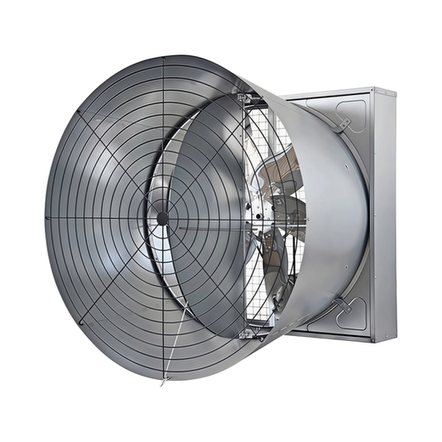
Test Each Poultry Farm Exhaust Fan Under Working Conditions
Bring in one stage and wait. Note the settled pressure, listen, and watch the doors. Add the next stage and repeat. A different drive note or slow butterfly door now belongs to a particular fan, rather than to a vague complaint about the whole wall. Where suitable meters are available, motor current belongs on that same line of the record.
The published number still needs context. On the DH(D)-1380A butterfly cone exhaust fan, the page pairs a 1,270 mm, six-blade propeller with a 1.1 kW motor and 51,020 m3/h at the stated test condition. Installation adds its own terms: guards, pads, light traps, inlet area, and leakage. A revised term can mean a revised operating point.
Verify Tunnel Ventilation Airflow at Bird Level
Chest height in the center aisle is a pleasant place to hold an anemometer. It is also a poor stand-in for the flock. Take the instrument down to bird level, working from pad end to center and fan end. Cross the width too. Feed lines, posts, cages, and partitions leave local shadows that disappear inside a house average.
People walking the route will disturb the birds, so pause before interpreting their position. After they settle, notice where they return. A crowded bay, repeated panting along one line, or an unused patch under a sharp jet deserves its own reading. One impressive number cannot sign off a house full of unexplained quiet spots.
Match the Poultry Cooling Pad to Fan Capacity and Humidity
Give the pad more than its first splash. Follow one complete lap of water from sump to pipe, across the media and frame, then into the return. A dry stripe sends you back towards distribution. A puddle sends you elsewhere, perhaps towards excess flow, torn media, poor sealing, or a return problem.
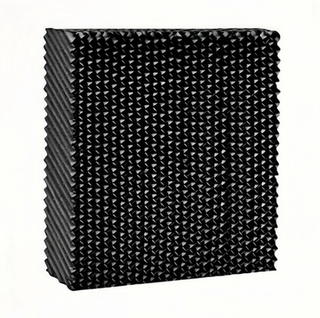
DAIHO Ventilation makes its وسادة تبريد تبخيرية from cellulose honeycomb media. The 7090 and 6090 entries each show three depth choices: 100, 150, and 200 mm. Put that choice beside the fan curve, not in a separate purchasing box. More media also means more resistance for the fan to overcome.
The weather can still veto a tidy installation. Record the dry-pad condition, wet the media, and see what was actually bought: how much temperature fell, and how much moisture rose. A long water cycle that produces mainly the second number needs reconsidering.
Set Up Poultry Farm Ventilation Controls for Fast Response
Ask the controller to perform before the hot day arrives. Minimum ventilation should hand over cleanly to each later stage, with pad water waiting for its intended cue. Leave a separate temperature and humidity meter among the birds. The installed sensor may be perfectly honest about the warm roof air or stray spray surrounding it, yet wrong for the flock below.
Power-loss rehearsal belongs with the farm electrician, never with an improvised switch-off around vulnerable birds. Time the generator, emergency opening, alarm, controller restart, and fan recovery. The phone named for nights must receive and acknowledge the test. When pressure, bird-level speed, and bird behaviour still tell different stories, send the readings and house plan to our team. It is a far better conversation before the heat alert.
الأسئلة الشائعة
Q: When should hot-season ventilation testing begin?
A: Start soon enough to fail once. There should still be a day for repair and another for proving the repair under load. Fan work, a deep clean, replacement media, or changed stocking conditions all reset part of the earlier result.
Q: Why can a running poultry fan still give weak airflow?
A: A turning motor proves rotation, not delivery to the birds. Speed can disappear at a belt, airflow at a dirty blade or stubborn shutter, and pressure through leakage, a tight inlet, or the pad. The fan may sound entirely occupied throughout.
Q: When should poultry cooling pads be switched on?
A: Begin with the required air exchange. Wet the pad next and watch two readings, not one: temperature down, humidity up. When the second movement dominates, keeping the pump on longer is unlikely to rescue the result.
 English
 Russian
 Arabic
 Spanish
 French
 Italian