

Evaporative Air Cooler vs Cooling Pad System for Industrial Spaces
A packaged evaporative air cooler and a cooling-pad wall use the same basic principle: water evaporates into moving air and reduces its dry-bulb temperature. The difference is how each system integrates with the building. A packaged unit brings its fan, pump and media together; a pad-wall system relies on the building opening, fans, water distribution and exhaust route. That distinction affects installation, maintenance and the area that actually receives cooled air.
Quick comparison: packaged cooler or pad wall?
|
Consideration |
Packaged evaporative air cooler |
Cooling-pad wall system |
|---|---|---|
|
Typical fit |
A specific work zone, changing floor layout or a smaller initial installation |
A stable intake wall serving a larger, planned ventilation route |
|
Main equipment |
Cabinet with fan, pump, media and water tank or connection |
Pad media, frame, water loop, intake opening and matched exhaust fans |
|
Air distribution |
Depends on discharge direction, distance, obstacles and available relief air |
Depends on intake area, building crossflow, fan duty and exhaust location |
|
Building work |
Placement, electrical, water and sometimes ductwork or mounting |
Wall opening, frame/supports, fans, water system, drainage and service access |
|
Service focus |
Pad, tank, pump, filters, hose and safe unit placement |
Media replacement, distribution header, trough, frame and fan access |
Neither design has an inherent advantage in energy use or cooling effectiveness. The comparison only becomes meaningful once both are evaluated for the same outdoor conditions, operating hours, air volume and occupied-zone target.
When a packaged air cooler is a practical option
A packaged cooler can be useful where cooling demand is concentrated near a workstation or where the production layout may change. It avoids the need to design an entire pad intake wall at the outset, although a fixed mounted cooler can still require ductwork and structural changes. Confirm whether the quoted product is mobile or fixed instead of assuming every cabinet is portable.
For example, DAIHO’s 18000 CMH Duct Air Cooler range includes the DH-18ASY at 18,000 m³/h, 1.1 kW, water consumption of 10–15 L/h and a 300 L tank. The page lists a 380V/50Hz manual-control option (DH-18ASY) and a 220V/50Hz LCD option (DH-18ASY/BP). This wheeled, directional-outlet product differs from DAIHO’s fixed-outlet 25000 CMH air cooler. Model and outlet layout must follow the actual quotation.
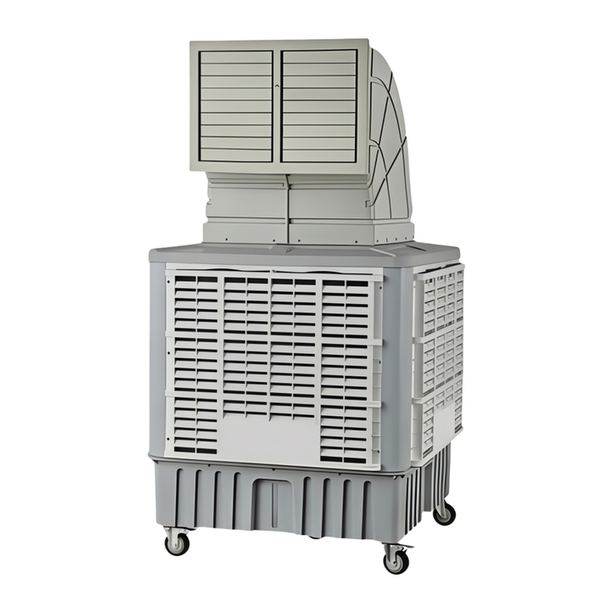
DAIHO 18000 CMH duct air cooler with directional outlets.
For any cabinet unit, mark the direction of discharge, normal worker positions, racks and partitions. A trial should record temperature and air movement at the workstation, not only next to the grille. Additionally, verify that the water supply, power cable, drain or overflow can run safely without obstructing forklifts and aisles.
When a cooling-pad wall is the stronger layout
A pad-wall design turns part of the building into an air intake. Air passes through wetted media and is drawn across the occupied space by a properly selected fan arrangement. This can be useful when the building has a stable intake face, a planned crossflow route and room for a water loop. It is not simply a matter of buying enough square metres of cooling media.
DAIHO’s cooling pad range with stainless-steel frames lists 7090 and 6090 media with standard heights of 1,200–2,000 mm, widths of 300 or 600 mm and depths of 100, 150 or 200 mm. The listed 5090 entry is customizable. These are product dimensions, not a prediction of installed performance. The fan duty, frame, usable air opening, water distribution and pressure drop still need to be specified together.
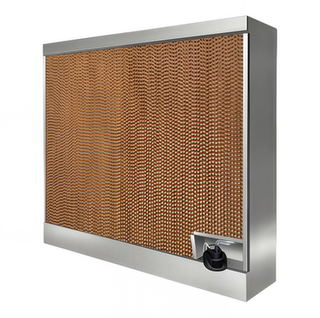
DAIHO cooling pad wall with a stainless-steel frame and evaporative media.
If the project uses a stainless-steel frame, the approval drawing should show actual dimensions, supports, header and pump position. It should also detail the bottom trough, overflow, drain and the route for replacing worn media. A photograph of a pad block cannot establish how an entire wall assembly will be installed.
A simple pad-area calculation—and its limit
Suppose a proposed system needs 36,000 m³/h of airflow, equivalent to 10 m³/s. Four panels, each 2,000 × 600 mm, provide 4.8 m² of gross face area: 10 ÷ 4.8 ≈ 2.08 m/s. Six panels provide 7.2 m²: 10 ÷ 7.2 ≈ 1.39 m/s. Six 600 mm-wide panels also occupy at least 3.6 m of wall width before allowing for supports and frame members.
These numbers are geometry checks, not recommended design velocities. The true open area is smaller than the gross face area, and the fan will operate against resistance from wet media, louvers and other components. Request the pressure-drop information for the proposed media depth and face velocity, then check the fan operating point. The same calculation cannot predict final room temperature.
Climate, humidity and airflow matter more than the label
Both options are forms of direct evaporative cooling. Their temperature reduction depends strongly on incoming air conditions: the smaller the difference between the dry-bulb and wet-bulb temperatures, the less cooling potential remains. Both also add moisture to supply air. Buildings with humidity-sensitive materials, limited relief air or poorly controlled doors require particular care.
The route through the occupied zone is equally important. A pad wall with adequate area may still perform poorly if exhaust fans bypass the workstations. A high-airflow cabinet may cool only the space beside the outlet if partitions block the airflow. Measure representative points during normal production, including the usual open and closed doors.
Installation and maintenance: the hidden part of the comparison
A packaged unit concentrates service in the cabinet: cleaning media and the tank, checking the pump, protecting the cable and keeping access around the unit. With a pad wall, the recurring work includes inspecting water coverage across the media, cleaning the trough, monitoring scale or debris and accessing the frame and fans. Water quality and an appropriate drain matter in both cases.
A pad-wall system may justify its installation work in a building with a permanent ventilation arrangement. A packaged unit may be easier to trial or relocate in some settings. Neither conclusion can be drawn from equipment price alone: compare installed cost, expected operating schedule, fan and pump power, water use, maintenance access and future changes to the building.
What to include in the RFQ
Site conditions: summer dry-bulb and wet-bulb temperatures or humidity, occupied-zone targets and the building’s normal door schedule.
Packaged option: exact model code, outlet direction, power supply, water source, tank/refill approach, discharge route, service space and proposed trial positions.
Pad-wall option: opening and frame drawing, media dimensions, usable face area, pressure loss at the planned flow, fan operating point, water distribution, drain and media-replacement route.
Acceptance: measurement locations and operating conditions for comparing the finished system against the proposal.
The practical choice is not “air cooler or pad wall” in isolation. It is the arrangement that can deliver useful cooling to the right work area under the site’s actual climate and operating conditions.
FAQs
Is a cooling-pad wall always more efficient than a packaged air cooler?
No. Both rely on evaporation. Compare complete installed systems under the same ambient conditions, including fan and pump power, airflow resistance, water use and the temperature achieved in the occupied zone.
Can a wheeled 18000 CMH duct air cooler replace a pad wall?
It may serve a particular zone, but it does not reproduce a building-wide intake and exhaust arrangement automatically. A trial and a site-specific airflow layout are needed.
Do deeper pads guarantee better cooling?
No. A deeper medium changes contact area and resistance. Its effectiveness depends on airflow, wetting uniformity, media geometry and fan capability. Ask for performance and pressure-loss information at the intended operating point.
Are evaporative systems suitable for humid factories?
Their effectiveness is limited when the wet-bulb temperature is high. Check the design weather data, acceptable indoor humidity and ventilation path before committing to either option.
 English
 Russian
 Arabic
 Spanish
 French
 Italian