

How to Reduce Condensation in Warehouses and Production Facilities
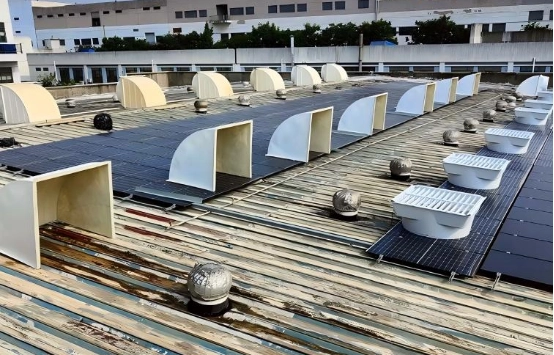
Condensation is a common problem in industrial buildings. Many of these structures have metal roofs and operate in environments with high moisture levels or insufficient airflow. Water droplets show up on roof sheets. They form on pipes, machinery, and stored goods. If you do not treat it, this moisture leads to rust. It can also encourage mold growth, damage packaging, create electrical failures, and reduce product quality.
Why Does Condensation Form in Industrial Buildings?
Moisture can enter with outdoor air. It also comes from industrial processes. These include washing, steam generation, food processing, textile production, industrial laundry, and wet materials.
Machinery releases heat. Warm and humid air rises as a result. Roof panels or structural steel may sit below the dew point. Pipes and ducts can do the same. Water vapor then condenses on these colder surfaces. This occurs often in high-bay buildings with metal roofs. Those roofs cool down fast at night or early in the morning.
Poor ventilation increases the risk. Moisture appears faster than it can leave the building. Humidity then builds up near the roof. It collects in areas with limited airflow.
How Does Poor Airflow Make Condensation Worse?
Humid air stays trapped in many spots. It gathers beneath the roof. It hides between storage racks. Areas behind machinery and remote corners can also retain humid air.
Typical problem areas include roof beams. High-level pipework creates issues. Lighting fixtures, electrical equipment, and products on upper racks face risks too.
Air circulation and air exhaust serve different purposes. A circulation fan moves air inside the building. An exhaust fan removes air from the building. Circulation reduces local humidity pockets. However, it cannot remove moisture from the building. The air needs discharge or dehumidification first.
Which Ventilation Equipment Helps Control Condensation?
The right equipment depends on where moisture is generated and where it accumulates.
Rooftop Exhaust Fans
Rooftop exhaust fans are suitable when warm, humid air collects near the ceiling. Installed at the highest part of the building, they remove rising heat and moisture before it condenses on roof panels and structural components.
Typical applications include high bay warehouses, food processing plants, textile facilities, and industrial laundries.
A rooftop exhaust system operates by creating negative pressure inside the building. As indoor air is discharged, replacement air enters through planned louvers, doors, or other openings.
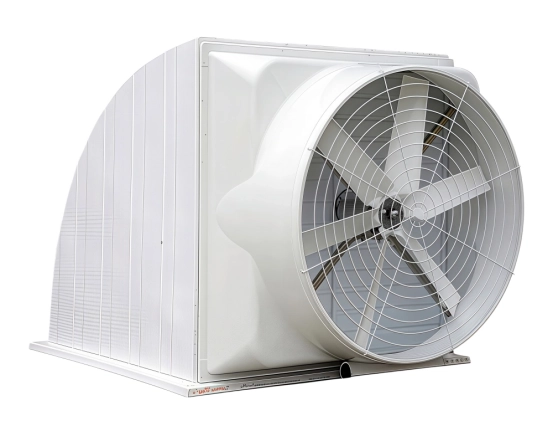
For facilities exposed to weather or corrosive conditions, an FRP rooftop exhaust fan can provide a suitable solution. DAIHO Ventilation’s rooftop-mounted FRP exhaust fan removes high level warm air, while its fiberglass reinforced plastic housing provides resistance against weather exposure, ultraviolet exposure, and corrosion.
Fan capacity should be selected according to building volume, moisture load, operating hours, and available make up air—not only the roof opening size.
Wall Exhaust Fans
Wall exhaust fans work well when moisture is concentrated around a production line or at a lower level. They can create cross ventilation when fresh air inlets are placed on the opposite side of the building.
The airflow path is a critical design factor. If an open door is beside an exhaust fan, incoming air may leave immediately without ventilating the rest of the facility.
Circulation and HVLS Fans
Circulation fans and HVLS fans reduce stagnant air around racks, machinery, and corners. They can guide humid air toward exhaust points and improve temperature uniformity.
However, they do not remove moisture from the building. Circulation fans redistribute humid air, while exhaust fans remove it from the building. Facilities with continuous moisture production may require both.
When Is Ventilation Alone Not Enough?
Ventilation works effectively when replacement air holds less moisture. This must be less than the moisture content of the exhausted air. Hot and humid climates change the picture. Introducing more outdoor air can also introduce additional moisture into the building.
Ventilation may fall short at times. Some production processes may continuously release steam. Condensation can continue after shutdown. Some products need tight humidity control.
An industrial dehumidifier fits these cases. It removes moisture no matter the outdoor conditions. It helps maintain stable humidity levels for sensitive materials and processes.
Evaporative cooling needs careful review. It cools air by adding moisture. It should not be considered a replacement for dehumidification in buildings with existing high humidity levels.
Should You Use an Exhaust Fan, a Dehumidifier, or Both?
| Facility condition | Recommended equipment | Main purpose |
| Humid air collects beneath the roof | Rooftop exhaust fan | Remove rising heat and moisture |
| Moisture is concentrated near machinery | Wall or local exhaust fan | Capture moisture near the source |
| Damp air remains between racks | Circulation or HVLS fan | Improve air distribution |
| Outdoor air is also humid | Industrial dehumidifier | Remove moisture without relying on outdoor air |
| Moisture load and poor airflow occur together | Exhaust fans and dehumidifiers | Control airflow and humidity |
Exhaust fans suit facilities that need to remove heat, odors, and moisture together. Dehumidifiers are better when a defined humidity range must be maintained. Many facilities require both systems to achieve effective moisture control.
How Should a Condensation Control System Be Designed?
First, identify the moisture source. Check whether it comes from production, outdoor air, wet materials, cleaning operations, open water sources, or roof and pipe leaks. Ventilation cannot solve moisture problems caused by structural leaks.
Next, place exhaust equipment where humid air collects. Rooftop fans are suitable for high level moisture, while wall or local exhaust fans suit specific process areas. Add circulation fans where racks or machinery block airflow.
Make up air requirements must also be considered during system design. Inlets should be far enough from exhaust fans to draw air through the problem area rather than directly to the nearest fan.
Key design factors include:
- Building volume
- Moisture generation rate
- Required air change rate
- Fan airflow capacity
- Make up air inlet size
- Operating schedule
- Seasonal outdoor conditions
Selecting fans without considering these factors can increase energy consumption. The condensation problem may remain.
How Can You Prevent Condensation from Returning?
Keep fan blades, shutters, louvers, and air inlets clean because blockages can reduce airflow performance.
Leave clear air passages between racks, walls, and exhaust points. In some facilities, fans should continue running after production stops to remove residual heat and moisture.
Monitor temperature and relative humidity at several heights, especially near the roof and moisture producing equipment. Seasonal changes may require different fan schedules or greater use of dehumidification.
Frequently Asked Questions
Q: Can exhaust fans completely stop condensation?
Not always. Performance depends on outdoor humidity, fan capacity, make up air, and the moisture source. Some facilities also require dehumidification or insulation improvements.
Q: Where should an exhaust fan be installed?
Install it near the area where heat and moisture collect. Rooftop fans suit rising warm air, while wall or local exhaust fans suit moisture generated around specific equipment.
Q: Do circulation fans reduce humidity?
No. They improve air movement but do not remove water vapor. They should be used with exhaust or dehumidification equipment.
Q: Is an FRP exhaust fan suitable for humid environments?
Yes. FRP housings suit wet, outdoor, and mildly corrosive environments where conventional metal housings may deteriorate faster.
Match the Equipment to the Moisture Source
No single system fixes every condensation problem. Rooftop fans clear humid air from high areas. Wall fans manage local sources. Circulation fans reduce still zones. Dehumidifiers control moisture when outdoor air cannot dry the space.
Assess key details before equipment selection. Note where moisture begins. Observe where it gathers. Understand air movement through the facility. A properly designed combination of exhaust, make up air, circulation, and dehumidification will perform better than simply adding more fans.
 English
  Russian
  Arabic
  Spanish
  French
  Italian