

7090 vs 6090 vs 5090 Cooling Pads: How to Choose the Right Evaporative Cooling Media?
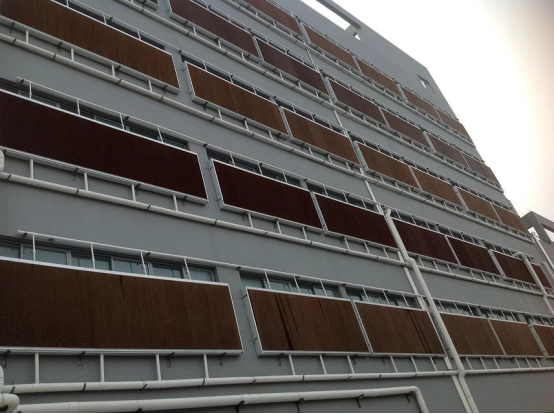
Cooling pad selection often starts with three common model codes: 7090, 6090, and 5090. That is where confusion begins.
The numbers look like a ranking, but they are not. Performance depends on geometry, depth, face velocity, fan pressure, water distribution, and system layout.
A poor match may look acceptable during commissioning. Problems appear later: weak airflow at the far end of a workshop, droplets leaving the pad face, or fans running outside their efficient range.
What Do 7090, 6090 and 5090 Cooling Pad Codes Mean?
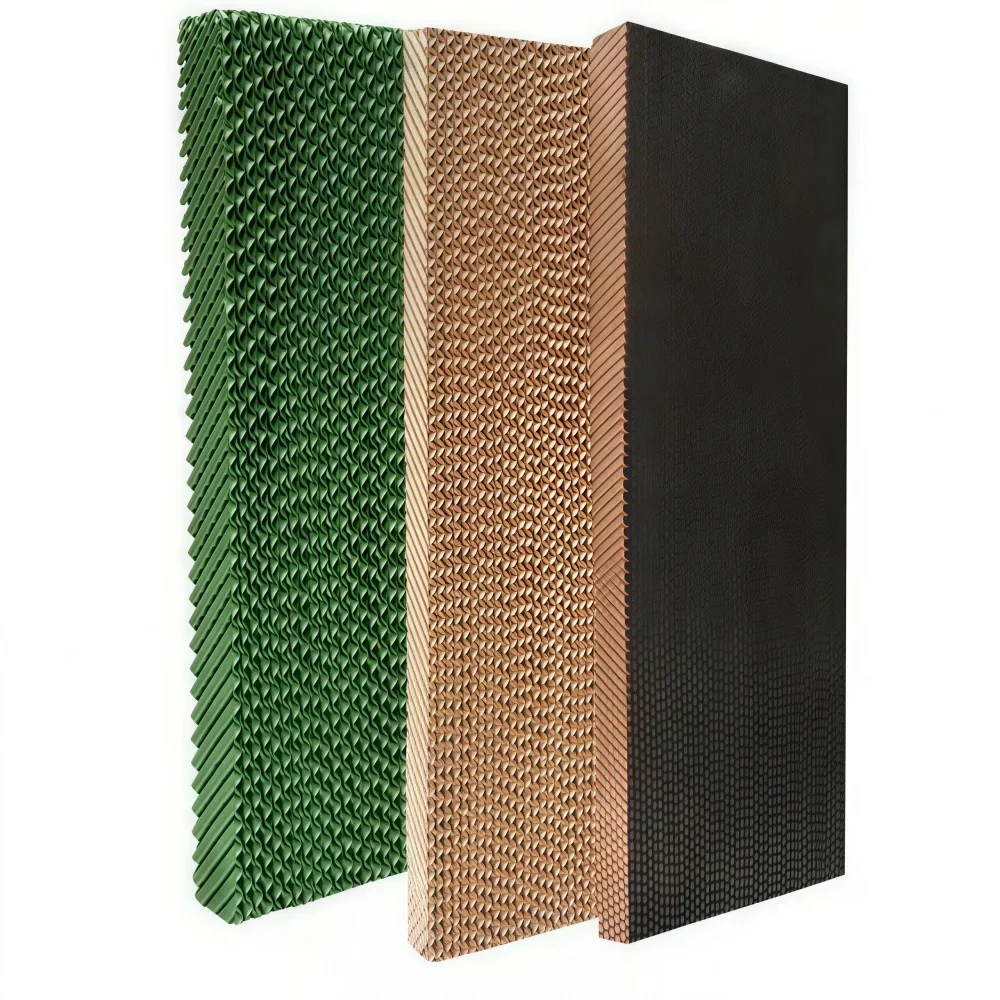
These model codes generally identify the corrugation pattern of evaporative cooling media. Definitions can vary between manufacturers, so the code should not replace detailed product specifications.
The useful details are flute height, corrugation angle, channel spacing, and pad depth. These factors determine how air moves through wetted paper and how long it remains in contact with water.
In DAIHO Ventilation’s original brown cooling pad range, 7090 and 6090 media are listed with a 7 mm waviness height, while 5090 uses 5 mm. That suggests different channel density, not automatic superiority.
Pads with the same code may still use different paper weights, resin treatment, or tolerances. Their pressure drop and water absorption can differ noticeably.
Which Cooling Pad Specifications Should Buyers Compare First?
The model number is only one line in a useful comparison.
| Specification | 7090 | 6090 | 5090 | Impact on System Performance |
| Waviness height | 7 mm | 7 mm | 5 mm | Channel density |
| Corrugation angle | 45°/45° | 45°/45° | 45°/45° | Airflow and wetting |
| Common depth | 100, 150, or 200 mm | 100, 150, or 200 mm | Often customized | Contact time and resistance |
| Typical application | Large pad walls | General cooling systems | Compact units | Initial selection |
Buyers should also request pressure drop at the intended operating point, including pressure drop, face velocity, saturation efficiency, water flow, maximum operating velocity, paper density, and surface treatment.
How Do Pad Geometry and Depth Affect Cooling System Performance?
Pad geometry changes the balance between evaporation and resistance. Increasing air–water contact can improve cooling, but additional resistance does not always provide better results.
Cooling efficiency and air–water contact
Evaporative cooling needs a stable water film and enough contact between air and the wetted surface. A denser structure may increase contact area, but it may also restrict airflow or collect more dust.
The pad must be wetted from top to bottom. Dry streaks create uneven outlet temperature, often caused by poorly designed distribution pipes or insufficient pump flow.
An efficiency figure without water flow, pad depth, and face velocity has limited value.
Airflow resistance and fan performance
Every cooling pad adds static pressure, and the fan must overcome this additional resistance.
A fan selected only by free air volume may lose capacity once pad and building resistance are added. In a negative pressure factory, the area near the pad may feel cool while the opposite side stays hot.
Check the fan curve and pad pressure drop curve together. A 200 mm pad may improve evaporation, but not when the fan cannot maintain airflow.
Pad depth and water carryover
Pad depth affects contact time, but a deeper pad is not always the better choice. High face velocity can pull droplets from the media, especially when water flow is excessive or installation is poor.
A 100 mm pad may be suitable for a compact unit with air intake from three sides. The same depth may be inadequate in a large wall system. A 150 or 200 mm pad may offer more cooling if the fan has enough pressure capacity.
Which Cooling Pad Is Better for Different Applications?
There is no universal best cooling pad. Application geometry usually decides more than the model code.
Large factories, greenhouses and poultry houses
Large pad wall systems need stable airflow across a wide surface. Low resistance, even wetting, and correct fan spacing are often more important than minor differences between pad models.
A 7090 pad is often considered for high volume wall systems, but it should not be selected without pressure drop data. In a long greenhouse or poultry building, the real question is whether the fans can pull the required volume through the full pad area.
DAIHO Ventilation offers 7090, 6090, and 5090 cellulose pads for these systems. The practical value is matching geometry and depth to the building instead of forcing one panel into every project.
Compact and integrated evaporative coolers
Compact evaporative coolers have different design limitations. Cabinet size, intake area, fan position, and water carryover become dominant.
DAIHO Ventilation’s integrated cooling fan uses 5090 pads on three sides at 100 mm thickness. Air enters through several faces, maintaining intake area without a large pad wall.
For this type of unit, 5090 media can make sense. It still needs proper pump flow and cleaning access. High-density media in a limited cabinet space can quickly create maintenance challenges.
Cooling Pad Selection for Retrofit and Custom Installations
Retrofit projects rarely follow catalogue dimensions.
An existing frame may have a fixed height of 1,780 mm. The fan may already be fixed. The water tank may be too small for a deeper pad. Custom dimensions can matter more than changing from 6090 to 7090.
Frame material have a fixed height of 1,780 mm. Galvanized steel may suit a dry industrial space. Aluminum or stainless steel may be more appropriate where humidity, chemicals, or washdown are present.
What Project Data Is Needed Before Requesting a Quotation?
A useful quotation starts with operating data.
Buyers should provide outdoor dry bulb temperature, relative humidity or wet bulb temperature, required airflow, target indoor temperature, available pad area, fan model, static pressure, pad dimensions, water quality, operating hours, and installation environment.
For a negative pressure system, describe the airflow path. Air must enter through the pad, cross the occupied zone, and leave through the fans. Incorrect openings can disrupt the airflow path and make a correctly sized pad look ineffective.
A simple sketch often prevents more mistakes than a long equipment list.
How Do Maintenance and Water Quality Affect the Best Choice?
Cooling pads do not maintain their original performance without proper maintenance.
Mineral scale can block channels, dust can accumulate on wet surfaces, and algae can develop where water remains warm and stagnant. As blockage increases, pressure drop rises and airflow falls.
Tighter channels can foul faster in hard water conditions. In one workshop, airflow dropped after a season because the bleed off rate was too low. The pad was blamed. The water system was the cause.
Lifecycle cost should include cleaning, replacement access, pump energy, fan energy, downtime, and water treatment.
What Should Buyers Include in the Final Cooling Pad Specification?
The final specification should state the pad model, corrugation geometry, height, width, depth, design airflow, face velocity, pressure drop, expected saturation efficiency, water flow, paper treatment, frame material, and dimensional tolerance.
DAIHO Ventilation’s original brown cooling pad is available in several standard depths and frame materials, while 5090 dimensions can be adapted for compact units or retrofit work.
Selecting by “7090 versus 6090 versus 5090” is too simple. Select by airflow, pressure, climate, water quality, and installation geometry. The model code should be considered after these factors.
FAQ
Q: Is a 7090 cooling pad always more efficient than a 6090 pad?
No. Efficiency depends on face velocity, pad depth, water flow, paper quality, and test conditions. Compare data at the same operating point.
Q: Can a 5090 pad be used in a large factory cooling wall?
It can, but pressure drop, pad area, maintenance, and water carryover must be checked.
Q: Should buyers choose a thicker cooling pad?
Only when the fan can handle the added resistance and the application benefits from longer air water contact.
Q: What information should be sent before asking for a recommendation?
Send airflow, outdoor temperature and humidity, fan data, pad dimensions, installation area, water quality, and operating hours.
 English
  Russian
  Arabic
  Spanish
  French
  Italian