

Ventilateurs de plafond HVLS: conseils stratégiques pour un débit d'air maximum
Caractéristiques clés des ventilateurs de plafond HVLS
Différences entre HVLS et ventilateurs à grande vitesse traditionnels
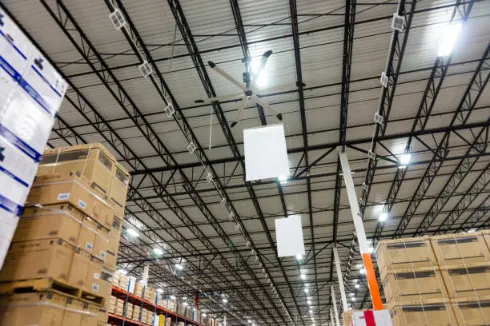
Ventilateurs de plafond à haut volume et basse vitesse (HVLS) se distinguent des ventilateurs à grande vitesse réguliers. Ils traitent le mouvement de l'air et la consommation d'énergie de différentes manières. Ces ventilateurs fonctionnent à des vitesses lentes. Ils ont de grands diamètres, généralement de 2,1 à 7,3 mètres. Cette configuration leur permet de pousser beaucoup d'air à travers de vastes zones. Et ils le font avec peu de pouvoir.
Les ventilateurs réguliers à grande vitesse assurent des flux d'air serrés, rapides et bouleversés. Les ventilateurs HVLS, en revanche, produisent de larges flux d'air en forme de colonne. Ces flux descendent et se propagent dans un cercle complet à 360 degrés. Un tel flux d'air lisse couvre de grands espaces de manière uniforme et fonctionne mieux. De plus, les formes de lames intelligentes et les moteurs modernes réduisent beaucoup la consommation d'énergie.
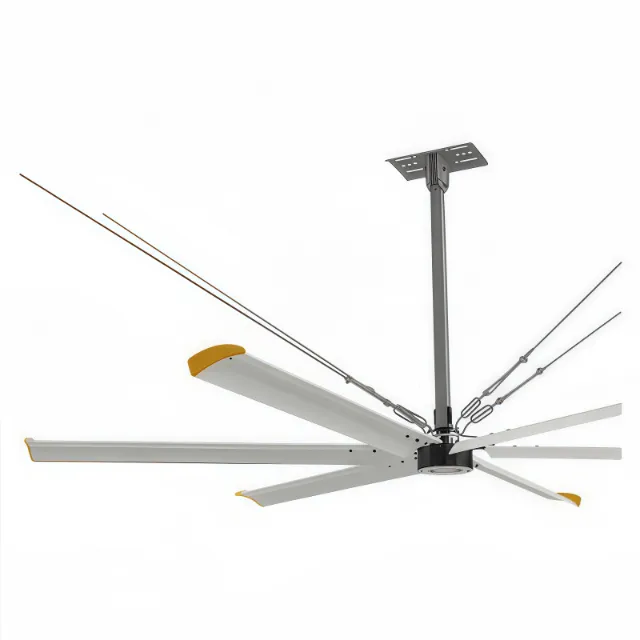
Le moteur à aimant permanent a une bobine isolée forte à l'intérieur. Il comprend un corps magnétique puissant, des roulements résistants à la chaleur, une puissance élevée dans un petit espace et une accumulation de chaleur faible. Tout cela permet d'économiser de l'énergie et de prolonger la durée de vie du ventilateur.
Caractéristiques structurelles et mécaniques de la conception de lame de ventilateur HVLS
Le bon fonctionnement d'un ventilateur HVLS dépend en grande partie de sa configuration de lame. Les lames proviennent d'un alliage d'aluminium cuivre magnésium zinc résistant. Ils se façonnent en douceur avec des méthodes de moulage modernes. Ils se forment comme une pièce solide. Cela les rend légers mais forts. Leur forme en forme d'aile réduit la traînée. Il améliore également la couverture aérienne.
Des outils comme le convertisseur de fréquence Kewo permettent des réglages précis de vitesse. Cela répond à divers besoins. Vous pouvez les installer dans des usines ou des fermes. Ces qualités de construction stimulent la ténacité et la stabilité.
Avantages fonctionnels dans les environnements industriels et commerciaux
Dans les grandes zones ouvertes, Ventilateurs HVLS apporter des avantages clés. Meilleur confort de la chaleur sans trop s'appuyer sur les configurations HVAC. Ils baissent la température du feutre jusqu'à 5°C. Cela aide la production des travailleurs. Meilleur mélange d'air qui gère l'accumulation d'humidité et d'eau
Le débit d'air peut atteindre jusqu'à 14 200 m³/min. ㎡. Ainsi, les ventilateurs HVLS s'adaptent à d'énormes endroits comme les bâtiments de stockage ou les salles de sport.
Considérations stratégiques pour l'installation de ventilateurs de plafond
Évaluation de l'architecture du bâtiment et de la hauteur du plafond
Vous devez vérifier le bâtiment’ s mise en page avant de mettre en ventilateurs. Les espaces ouverts avec des plafonds supérieurs à 3,8 mètres fonctionnent mieux pour les systèmes HVLS. Les usines de cadres en acier ou les sites industriels (au-dessus de 3,8 m) font de bons endroits pour eux.
Gardez l'espace loin des lumières, des conduits d'air ou des poutres. Cela permet de maintenir le flux d'air clair. Choisissez la taille du ventilateur en fonction de la taille de la pièce: par exemple, le modèle DH-XC-73 de 7,3 mètres fonctionne pour de grandes zones de stockage. Le DHPM-25 de 2,5 mètres convient aux petites zones de bureau.
| Hauteur du plafond | Diamètre de ventilateur recommandé | Exemple de modèle |
| 10 à 12 m | 7,3 à 8,6 m | DH-XC-73 |
| 7 à 10 m | 4,9 à 6,1 m | DH-XC-61 |
| < à 7 m | 2,1 à 4,3 m | DH-XC-25 |
Aligner le placement du ventilateur avec les objectifs de flux d'air
Le placement nécessite une réflexion, pas seulement au centre. Dans les grandes zones de stockage, les zones d'air se chevauchant donnent même répartis sur les étagères. Dans les usines, les ventilateurs ne doivent pas gâcher les tâches clés ou les vents de machine.
Les points principaux à considérer incluent:
Faites en sorte que les flux d'air se chevauchent dans de grands endroits
Correspondance de la direction du ventilateur aux voies d'air naturel ou d'échappement
Évitez les problèmes d'air près de poussières ou d'équipements sensibles à la chaleur
Intégration avec les systèmes HVAC existants
Les ventilateurs HVLS ne remplacent pas les HVAC. Ils le rendent meilleur. En combinaison avec les installations HVAC actuelles. Ils facilitent le travail de refroidissement en répartissant bien l'air. L'adaptation des flux d'air arrête le gaspillage d'énergie. L'utilisation intelligente des ventilateurs ajoute aux zones HVAC
Vous pouvez utiliser le zonage pour mélanger le refroidissement de la machine avec de l'air frais. Cela aide beaucoup dans les périodes plus douces de l'année.
Scénarios d'application dans les environnements industriels
Entrepôts et centres de distribution
Ici, la chaleur s'accumule près du toit. Les ventilateurs HVLS poussent cet air chaud dans les mois froids. Ou ils aident à transpirer en temps chaud. Ils maintiennent les conditions de stockage stables et réduisent les déchets dans les marchandises qui se gâchent facilement. Ils soutiennent la gestion du climat bon marché sur les grandes zones
Plantes de fabrication et lignes d'assemblage
Le confort au travail est lié à combien est fait. Ventilateurs de plafond HVLS déplacer l'air uniformement sur les lieux de travail. Ils coupent les taches chaudes. Les points de ventilateur évitent le désordre du vent autour des machines. Ils aident à atteindre les règles de confort au travail et à réduire les jours manqués par la chaleur
Installations agricoles et serres
Dans les zones agricoles, où la chaleur et l'humidité frappent fortement les cultures ou les animaux, les ventilateurs HVLS aident beaucoup.
Le mouvement de l'air crée la chaleur et l'humidité pour la santé des plantes ou les soins des animaux. Cela fonctionne bien avec les sécheurs ou les refroidisseurs à eau.
Optimisation des performances grâce à la planification professionnelle
L'importance de l'analyse computationnelle de la dynamique des fluides (CFD)
Les contrôles CFD sont très importants dans la planification de l'installation:
Il repère les taches d'air morts ou les zones de haute pression à l'avance
Il choisit le bon nombre et les bonnes places pour les fans
Il augmente la valeur en tirant le meilleur parti de la couverture
Il’ Il ne s'agit pas seulement de coller un ventilateur au milieu. Il’ s sur le guidage de l'air de manière stable.
Accès à la maintenance et efficacité opérationnelle à long terme
Une entretien facile est souvent manqué, mais il’ S clé.
Les choses à noter incluent: Des moyens sûrs d'atteindre les moteurs et les lames pour les serviettes. L'électricité coupe automatiquement si des problèmes frappent, pour la sécurité. Les pièces fortes réduisent les temps d'arrêt et prolongent la durée de vie du ventilateur.
Les plans devraient ajouter des temps d'entretien et atteindre les points élevés.
Rôle des fabricants experts dans la planification de l'intégration des systèmes
Travailler avec des fabricants qualifiés assure des liens en douceur dans les configurations climatiques complètes.
Ventilation DAIHO fournit des paquets complets. Ceux-ci mélangent des ventilateurs HVLS avec des refroidisseurs à eau et des sécheurs pour une gestion totale du climat. Leur aide couvre la configuration du site, les contrôles et les plans personnalisés à partir des conditions du site.
Améliorer la qualité environnementale grâce à une mise en œuvre réfléchie
Soutenir les objectifs de la qualité de l'air intérieur (QA)
La poussée d'air constante des ventilateurs HVLS amincisse les morceaux flottants comme la poussière ou les fumées.
En lien avec de bons filtres :
Il stimule la respiration facile
Il aide à respecter les règles de sécurité au travail
Il réduit les coûts pour l'entretien du filtre en étendant les bits même
Réduire la consommation d'énergie tout en maintenant le confort
Par beau temps, éteignez la climatisation mais utilisez les ventilateurs HVLS. Cela réduit considérablement les coûts de fonctionnement. Le lien avec les contrôles de bâtiment augmente les économies avec des ajustements intelligents.
Les ventilateurs comme le DHPM-25 ne consomment que 0,1 KW. Ils fonctionnent bien dans les petites et moyennes entreprises.
Créer des environnements de travail positifs grâce au contrôle du climat
Confort ain’ t juste agréable—it’ s clé pour le lecteur de travailleur.
L’idée « Travailler dans la brise, les travailleurs heureux ! » correspond à l’objectif de DAIHO Ventilation. Ils visent à améliorer les lieux de travail avec des flux d'air planifiés.
En réduisant les hauts et les bas de chaleur et en soulevant la qualité de l'air, ces configurations créent des endroits où les gens se concentrent plus et se fatiguent moins rapidement.
Questions fréquentes
Q: Quel ventilateur HVLS de diamètre dois-je choisir pour mon installation?
Cela dépend de la hauteur du plafond et du volume de la pièce; DAIHO propose des modèles allant de 2,1m à 7,3m de diamètre.
Q: Les ventilateurs HVLS peuvent-ils être utilisés parallèlement aux systèmes HVAC?
Oui, ils améliorent l'efficacité de la climatisation en distribuant l'air conditionné de manière plus uniforme sur de grands espaces.
Q: Comment les lames de ventilateur HVLS diffèrent-elles de celles traditionnelles?
Ils sont en forme d'airfoil et fabriqués à partir de matériaux en alliage léger qui maximisent le flux d'air tout en minimisant la consommation d'énergie.
Q: Les ventilateurs HVLS conviennent-ils aux environnements agricoles?
Absolument, ils aident à gérer l'humidité et la température pour les cultures et le bétail sans causer de stress par des flux d'air violents.
Q: Est-ce que DAIHO Ventilation fournit un support d'installation?
Oui, DAIHO Ventilation offre des services d'installation, de débogage, de test, d'entretien et de garantie sur place.
 English
  Russian
  Arabic
  Spanish
  French
  Italian