

Meilleur ventilateur d'extraction pour poulaillers : guide d'achat complet
Une bonne ventilation ne se limite pas à faire circuler l'air. Il s'agit de créer un environnement intérieur stable, propice à une croissance saine des volailles. Dans les poulaillers, chaque degré de température compte. Le taux d'humidité est tout aussi crucial. Sans une bonne ventilation, même une alimentation de qualité supérieure et une excellente génétique ne donneront pas les résultats escomptés.
Pourquoi la ventilation est importante pour la santé des volailles
Une ventilation adéquate permet de contrôler la chaleur, l'humidité et l'ammoniac à l'intérieur du bâtiment d'élevage. L'ammoniac peut facilement s'accumuler avec le temps, ce qui affecte le système respiratoire des volailles et augmente le risque de maladies. Un flux d'air constant et équilibré favorise une croissance plus rapide et améliore l'efficacité alimentaire. Une mauvaise ventilation entraîne des problèmes respiratoires et diminue la production globale de l'élevage.
Comment les ventilateurs d'extraction contribuent au contrôle environnemental
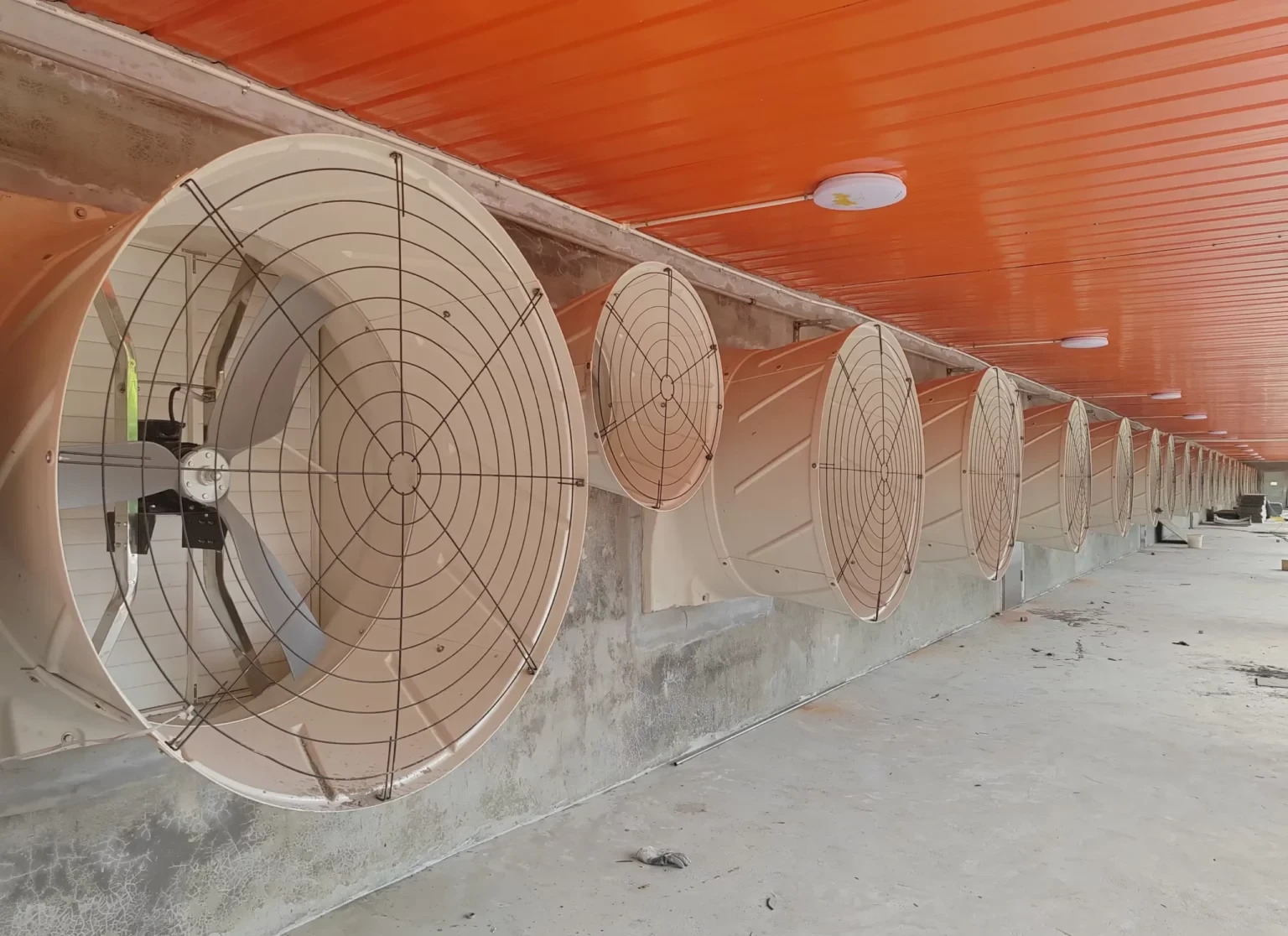
Ventilateurs d'échappement Agissant comme les poumons mécaniques d'un poulailler, les ventilateurs d'extraction éliminent l'excès de chaleur et d'humidité, ainsi que la poussière et les gaz nocifs présents dans l'air. Ces éléments indésirables s'accumulent suite à la respiration des volailles et à la décomposition de leurs déjections. Ils assurent un renouvellement constant de l'air dans le bâtiment, maintenant ainsi un climat intérieur stable.
Ce système fonctionne parfaitement même en cas de changements climatiques soudains. Ces ventilateurs peuvent être associés à des panneaux rafraîchissants ou à des systèmes de refroidissement à eau. Ensemble, ils créent une zone intérieure très confortable. Ce dispositif réduit considérablement le stress thermique chez les oiseaux pendant les chauds mois d'été.
Facteurs clés à prendre en compte lors du choix d'un ventilateur d'extraction pour les poulaillers
Choisir le bon extracteur d'air ne se résume pas à vérifier sa taille ou son prix. Il est essentiel d'adapter les performances réelles de la machine aux besoins spécifiques de votre exploitation.
Quelle taille de ventilateur d'extraction vous faut-il ?
La taille appropriée du ventilateur dépend fortement des dimensions physiques de votre poulailler. Le nombre total de volailles présentes joue également un rôle important. Vous devez d'abord calculer le volume total d'air. Ensuite, déterminez le nombre de renouvellements d'air nécessaires par heure. Par exemple, un poulailler de 20 000 poulets de chair requiert un volume d'air important.
Un poulailler d'élevage abrite moins d'oiseaux pendant une période plus longue, ses besoins en ventilation sont donc différents. Acheter des ventilateurs trop grands entraînera un gaspillage d'électricité. De plus, de grands ventilateurs peuvent créer des courants d'air froid indésirables. À l'inverse, de petits ventilateurs ne suffisent pas à brasser suffisamment d'air par forte chaleur.
Qualité des matériaux et de la fabrication : pourquoi la fibre de verre est importante
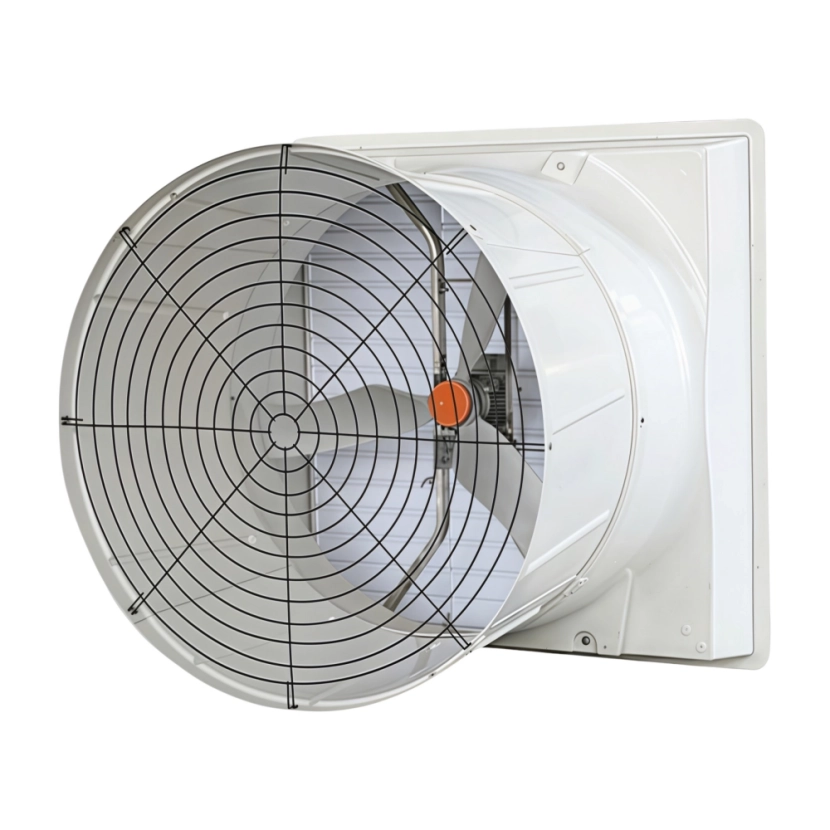
Les poulaillers sont saturés d'ammoniac, un gaz corrosif. Dans ces lieux, le métal rouille très rapidement. C'est pourquoi les extracteurs d'air en fibre de verre présentent un avantage considérable. Leur enveloppe extérieure résiste bien mieux à la rouille et aux dommages chimiques que les modèles métalliques classiques.
Ils sont assez légers tout en étant très robustes. Leur construction solide leur assure une longue durée de vie, même en fonctionnement continu. Les parois intérieures de ces ventilateurs sont parfaitement lisses, ce qui empêche la poussière épaisse d'adhérer et facilite grandement leur nettoyage.
Considérations relatives à l'efficacité énergétique et aux performances
L'efficacité énergétique influe directement sur les coûts d'électricité mensuels. Les moteurs à haut rendement consomment beaucoup moins d'électricité, tout en assurant un débit d'air important. La conception optimisée des pales assure une diffusion de l'air plus fluide et réduit les vibrations et le bruit à l'intérieur du bâtiment. Certains ventilateurs sont compatibles avec des variateurs de vitesse, permettant un réglage facile de la vitesse. Cette flexibilité est essentielle pour les exploitations agricoles modernes et intelligentes, car elle permet au système d'adapter automatiquement le débit d'air en fonction de la température intérieure et du taux de dioxyde de carbone.
Comparaison de différents types de ventilateurs d'extraction pour poulaillers
Le type d'alimentation et la conception physique d'un ventilateur sont deux éléments essentiels. Ces deux détails déterminent son efficacité en conditions réelles d'utilisation dans une exploitation agricole.
Transmission par courroie ou transmission directe : laquelle est la meilleure ?
modèles à entraînement par courroie Ces ventilateurs permettent de régler la vitesse en modifiant la configuration des poulies. Cette caractéristique en fait un excellent choix pour les agriculteurs qui souhaitent adapter la vitesse de l'air aux différentes saisons. Leur réparation est généralement simple. Toutefois, il est indispensable de vérifier régulièrement la tension de la courroie.
Les ventilateurs à entraînement direct ne comportent aucune courroie. Ce type de conception réduit considérablement la fréquence des réparations. De plus, leur vitesse de rotation reste généralement constante. Votre choix final dépendra principalement des besoins spécifiques de votre exploitation. Il vous faudra trouver un équilibre entre votre besoin de contrôle de la vitesse et votre volonté d'effectuer un entretien régulier.
Ventilateurs d'extraction de type conique ou de type caisson : quelle est la différence ?
Type conique Ces conceptions permettent une circulation d'air plus fluide et plus efficace. Elles y parviennent en réduisant la résistance de l'air à l'ouverture arrière. Cette forme ingénieuse génère une meilleure pression statique. Elles sont donc parfaitement adaptées aux grands élevages de volailles utilisant des bâtiments très longs ou des systèmes de ventilation en tunnel.
Les ventilateurs de type caisson nécessitent moins d'espace d'installation. Ils sont assez simples à monter dans les petites granges. Cependant, ils brassent généralement moins d'air que les modèles coniques. Aujourd'hui, de nombreux exploitants agricoles modernes optent pour les ventilateurs de type caisson. ventilateur d'extraction conique en fibre de verreIls préfèrent ce modèle car il permet de brasser une quantité d'air importante tout en résistant parfaitement à la rouille.
Conseils d'installation et de maintenance pour une fiabilité à long terme
Même un ventilateur d'extraction de haute qualité finira par tomber en panne. Cela arrive en cas d'installation incorrecte ou si l'entretien de base est complètement négligé.
Comment optimiser l'emplacement des ventilateurs d'extraction dans les poulaillers
L'emplacement des ventilateurs détermine la répartition du flux d'air à l'intérieur du bâtiment. Il est recommandé de les installer le long des murs latéraux ou aux extrémités du bâtiment. Ce positionnement judicieux assure une aspiration uniforme de l'air dans toute la zone. Les objets volumineux, tels que les silos à aliments ou les rideaux épais, ne doivent jamais obstruer la circulation de l'air. Ces zones stagnantes peuvent rapidement accumuler chaleur et humidité.
Conseils d'entretien régulier pour prolonger la durée de vie du ventilateur
Un entretien régulier garantit le bon fonctionnement de vos systèmes de refroidissement pendant des années. Examinez attentivement les pales du ventilateur et vérifiez qu'elles ne sont pas encrassées. Une épaisse couche de saleté ralentit le ventilateur et entraîne une surconsommation d'énergie. Pour les systèmes à courroie, vérifiez l'absence de fissures ou d'usure de la courroie. Graissez toujours les pièces mobiles conformément aux recommandations du fabricant. Négliger cette étape simple peut endommager le moteur principal prématurément.
Prêt à moderniser la ventilation de votre poulailler ?
Contactez DAIHO Ventilation Aujourd'hui, trouvez la solution de ventilation extra-plate adaptée à votre élevage de volailles.
FAQ (questions fréquentes)
Q1 : À quelle fréquence faut-il nettoyer les ventilateurs d'extraction dans les poulaillers ?
Il convient de les nettoyer au moins une fois par cycle d'élevage. Si l'air est très poussiéreux, il faut les laver encore plus souvent.
Q2 : Les ventilateurs d’extraction en fibre de verre valent-ils leur coût initial plus élevé ?
Oui, elles sont rentables à long terme. C'est particulièrement vrai dans les endroits où la concentration d'ammoniac est élevée. Dans ces environnements, les machines métalliques rouillent très rapidement. Les modèles en fibre de verre durent beaucoup plus longtemps et permettent de réaliser des économies sur les réparations.
Q3 : Est-il possible d’ajouter des variateurs de vitesse ultérieurement ?
La plupart des moteurs récents permettent l'ajout ultérieur d'un variateur de vitesse. C'est un investissement rentable à long terme. Toutefois, il est toujours préférable de prévoir cette option dès la première installation. En procédant tôt, vous vous assurez du bon fonctionnement de l'ensemble du système.
Q4 : Quelle est la durée de vie typique d'un ventilateur conique en fibre de verre ?
Si vous en prenez bien soin, le ventilateur durera très longtemps. Un lavage, une lubrification et une inspection de la courroie réguliers sont nécessaires.
 English
  Russian
  Arabic
  Spanish
  French
  Italian