

Warehouse Too Hot? Portable Industrial Air Cooler Solutions
The Hidden Cost of a Too-Hot Warehouse
Many warehouses look fine overall, with temperatures that seem manageable. But dig deeper, and areas like packing zones, loading docks, mezzanines, and spots near machinery turn into stifling warehouse hot spots.
Studies show that when temperatures climb over 90°F, productivity can drop by around 25%. Errors creep in, fatigue sets in faster, and safety risks rise.
Warehouse cooling problems often stem from ignoring these pockets of heat. A portable industrial air cooler steps in here, offering quick relief without massive overhauls.
In projects where DAIHO Ventilation has supported warehouse upgrades, managers rarely say “cool everything.” Instead, they point to a few problem zones that are always too hot, no matter what the thermostat says.
Why Warehouses Develop Local Heat Spots Instead of Even Temperatures
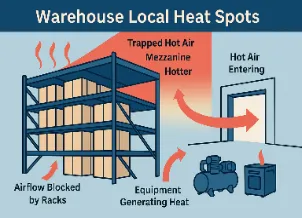
Warehouses rarely heat up evenly. High shelves block airflow, trapping warm air up top. Mezzanines collect that rising heat, making them feel like ovens.
Loading docks? Doors open and close all day, letting hot outside air rush in. These warehouse local heat spots hit hardest where employees spend the most time. Packers huddle in one corner, loaders cluster at doors.
Uneven warehouse temperatures mean some spots stay cool while others bake. Hot zones in warehouses form from poor circulation, too.
Why Cooling the Whole Warehouse Isn’t Always the Smart Move
Big warehouses with high ceilings and thousands of square feet make full central HVAC a beast to install and run. Dropping the entire space to 72°F? That eats up energy and racks up bills fast. Plus, much of the floor holds inventory, not people.
Warehouse cooling solutions shine when they focus on microclimates—those small areas where folks actually work.
Spot cooling vs central HVAC wins out for efficiency. Cooling only occupied zones saves cash and gets results quicker.
What Is a Portable Industrial Air Cooler and How Does It Work?
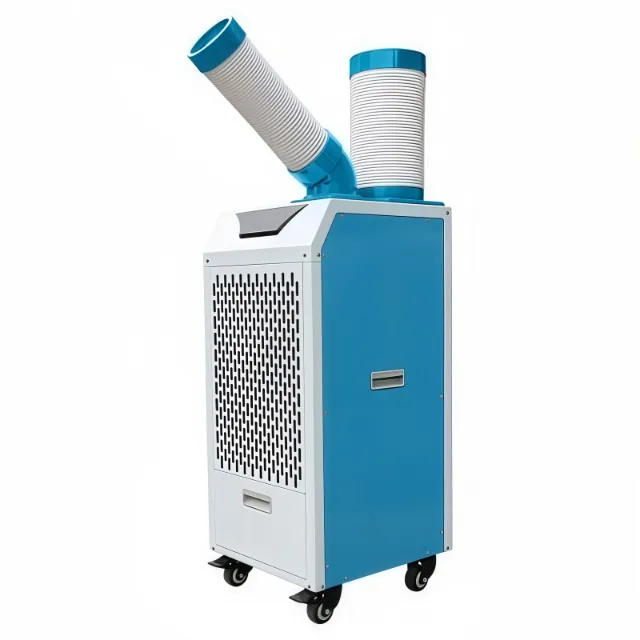
A portable industrial air cooler, or industrial spot air cooler, acts like a tough, movable AC built for rough settings. It uses a refrigeration cycle to pull in warm air, cool it down, and blast cold air through nozzles right where needed. Simple, but powerful for warehouses.
Think of it as a portable warehouse air conditioner on steroids. Airflow pushes cooled air far, without needing ducts.
For example, a model like DAIHO Ventilation’s DH-A-27B portable industrial air cooler delivers about 2.7 kW (≈9,200 BTU/h) of targeted cooling with dual cold-air nozzles and around 400 m³/h of airflow—enough to treat one or two busy workstations without overhauling the entire HVAC system.
Mapping Your Warehouse Hot Spots Before You Move a Single Cooler
Start with a basic sketch of the layout. Mark loading docks, packing areas, picking zones, mezzanines, and spots near heat-generating gear. That’s warehouse heat mapping in action.
Next, grab a thermometer or poll workers on peak heat times. Compare readings to spot consistent hot patches.
Prioritize by impact: how it hits people and products. Worker microclimate matters most in high traffic spots.
How a Portable Industrial Air Cooler Solves Local Heat Spots in Practice
Spot cooling in warehouses starts with picking the right capacity. For a small packing station, aim for 1–3 kW models. Larger areas or multiple spots? Go higher.
Position the unit close to the heat source or workers, but out of walkways. Leave room for intake air—don’t shove it against stacks.
In one packaging area, a DH-A-27B-class unit from DAIHO Ventilation was parked between two packing stations. Its dual adjustable nozzles were aimed at each operator’s “standing zone,” while a separate circulation fan pushed the cooled air down the aisle.
The rest of the warehouse stayed at ambient temperature, but the two stations dropped several degrees where it mattered most. Portable industrial air cooler placement like this turns hot messes into workable spaces. Spot cooling in warehouses proves flexible, too—move it as needs shift.
Key Considerations: Power, Airflow, and Condensate (Without Overcomplicating It)
Power requirements for portable air coolers vary. Check voltage and phase match—say, 220V/50Hz single Figure out how many units one circuit can handle without tripping breakers.
Airflow management in warehouses means directing cold air at people, not walls or shelves. Watch for racks, lifts, or curtains blocking the path. A little planning avoids wasted chill.
Condensate management is key. Some models have built-in tanks; empty them regularly. For long runs, hook up a hose to a drain or floor outlet. Keeps things dry and safe.
Best Practices for Keeping Workers Comfortable and Productive All Summer
Prioritize portable industrial air coolers at packing tables, picking paths, entry/exit points, and hot mezzanines. Those spots see the most action.
Adjust run times by shift—ramp up in afternoons when heat peaks, ease off at night.
Clean filters often to maintain airflow and air quality. Dust builds quick in warehouses.
Gather worker input. Fine tune nozzle angles or positions based on what they say. Improve worker comfort in warehouses this way, and watch morale climb.
Boost productivity with spot cooling by keeping folks focused, not fanning themselves. It’s about smart, not blanket, coverage.
Quick Checklist: Is a Portable Industrial Air Cooler Right for Your Warehouse Hot Spots?
Run through this warehouse spot cooling checklist fast:
Do just a few areas run extra hot?
Tough to install fixed AC without major work?
Got outlets or power nearby for units?
Workers griping about specific stations?
Budget for a trial on one or two spots?
Space to move gear around as layouts change?
Heat affecting output or safety in key zones?
Looking for quick wins over full renos?
If most check out, start with 1–2 portable units. Test the waters.
Start Small, Target the Hottest Spots First
Warehouses don’t need wall to wall AC to function well. Focus on the hottest, most impactful areas for people and goods. A portable industrial air cooler, plus basic airflow tweaks, offers a fast path to better conditions and solid ROI.
Pilot in one zone. Measure temps, hear from staff, then scale up. Cooling warehouse hot spots efficiently keeps operations humming through summer without breaking the bank.
Sometimes, the simplest fixes surprise with their punch. Give it a shot.
FAQ
Q: How can a portable industrial air cooler help reduce warehouse hot spots?
A portable industrial air cooler delivers targeted cooling directly to hot spots, such as packing lines or loading docks. Instead of cooling the entire warehouse, it lowers temperatures only where workers need it most.
Q: What causes hot spots in warehouses?
Warehouse hot spots usually come from poor airflow, high ceilings, heat generating equipment, and frequent door openings at loading docks. These factors create uneven temperatures even when the rest of the building feels comfortable.
Q: Is spot cooling more efficient than cooling the entire warehouse?
Yes. Spot cooling uses far less energy because it cools specific occupied zones rather than the whole building. This makes portable industrial air coolers a cost-effective alternative to large HVAC systems.
Q: Where should I place a portable industrial air cooler in a warehouse?
Place the cooler near workstations with the highest heat exposure—packing stations, mezzanines, or loading docks. Ensure clear airflow around the unit and aim the nozzles directly toward worker areas.
Q: What size portable industrial air cooler do I need for warehouse use?
Sizing depends on the size of the hot spot, worker density, and surrounding heat load. Small workstations may need a 1–3 kW cooler, while larger areas require higher capacity industrial models with adjustable airflow.
 English
  Russian
  Arabic
  Spanish
  French
  Italian