

Is Evaporative Cooling Effective in Hot and Humid Climates?
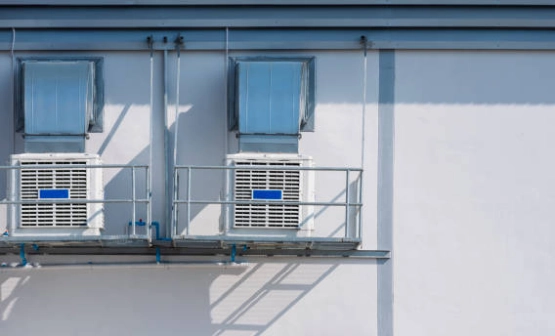
The short answer is yes, sometimes. Direct evaporative cooling becomes less effective as outdoor moisture rises. A facility may achieve useful cooling relief, or it may simply circulate warmer, more humid air.
An open bay workshop may only need worker relief and air movement. A packaging room may need humidity control as much as cooling. The same weather can lead to very different equipment choices.
How Evaporative Cooling Works
Evaporative cooling uses water evaporation to remove heat from the air. When water evaporates, it needs energy. That energy comes from the surrounding air, so the air temperature falls.
The limit is set by wet bulb temperature. Dry bulb temperature is the ordinary air temperature. Wet bulb temperature indicates how much evaporative cooling potential remains. A wide gap gives an evaporative system room to work. A narrow gap does not.
In a direct system, supply air passes through wet cooling media. It becomes cooler and more humid. An indirect system keeps the supply airstream separate from the wet side through a heat exchanger. As a result, its effect on indoor humidity is significantly different.
Why High Humidity Changes Cooling Performance
At higher humidity levels, the air has less capacity to accept additional moisture. That reduces the evaporation rate through direct cooling media and limits the achievable reduction in supply air temperature.
Direct cooling also adds moisture to the building. In a busy fabrication shop with doors open and roof extract running, that may be acceptable. In a closed room, it can mean condensation on metal or cause process conditions to drift outside the required tolerance.
Relative humidity alone is not enough for selection. A coastal plant can have a difficult afternoon and a favorable evening on the same day. Outdoor dry bulb and wet bulb temperatures matter, as do machine loads and process moisture.
When Evaporative Cooling Can Still Be Effective in Hot and Humid Climates
Hot and humid is a regional description. Equipment sees hourly conditions. Many facilities have periods when humidity falls enough for evaporative cooling to contribute useful relief, even during a wet season.
It is often practical in semi-open factories, loading zones, livestock buildings, and warehouses needing replacement air. A heat stressed loading crew near a dock does not always need a tightly controlled 24°C indoor environment. Cooler incoming air and steady air movement can change conditions quickly.
Air velocity matters here. Properly sized industrial fans carry heat away from people and prevent hot air from sitting under the roof. They also support the fresh air path required by a direct evaporative cooler. The system should have a clear route for air in and air out. A cooler installed in a sealed space will not behave like one serving a ventilated production floor.
The practical question is whether seasonal performance fits the facility’s comfort target and operating hours. Seasonal and hourly weather data should be used rather than relying on a single peak temperature reading.
The Limits of Direct Evaporative Cooling
Direct evaporative cooling is a poor fit when indoor humidity must stay low or stable. That includes many electronics areas, pharmaceutical spaces, precision production lines, and moisture sensitive storage rooms. Poor exhaust capacity creates another problem because moist air has no reliable path out of the building.
There are material concerns as well. Persistent humidity can accelerate corrosion on untreated metal. It can affect carton strength. It can complicate product inspection. These risks do not rule out evaporative cooling everywhere; they simply mean it should not be treated as a stand-alone solution.
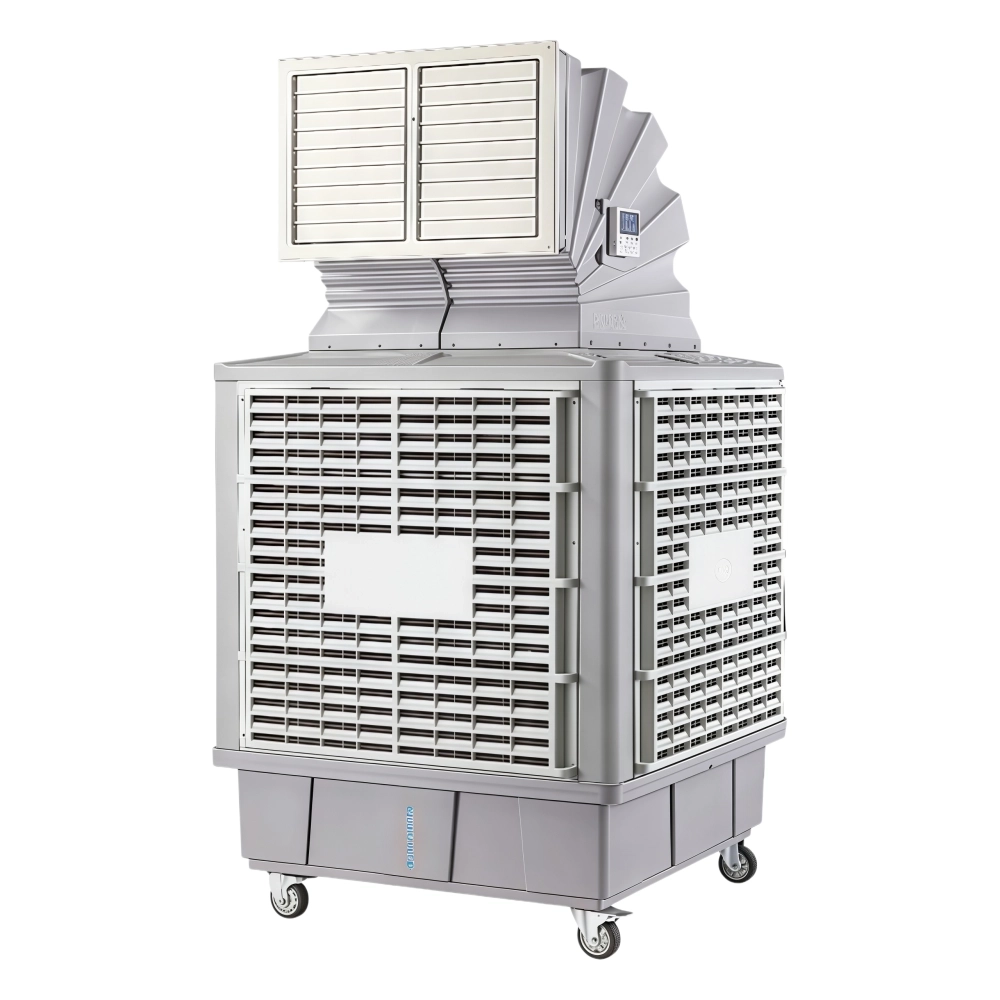
Better Approaches for Humid Industrial Environments
The usual remedy is not to abandon evaporative cooling. It is to give it a more specific job within the air management system.
Indirect Evaporative Cooling
Indirect cooling removes sensible heat without passing moisture into the supply airstream. That makes it attractive where a direct system could increase indoor humidity too much. The heat exchanger does add cost and design complexity, but it can preserve a workable humidity range while reducing the load on mechanical cooling.
This route deserves attention for enclosed production spaces that need fresh air. It also suits projects where evaporative cooling systems are being evaluated against conventional air conditioning rather than as a replacement for ventilation.
Hybrid Cooling and Dehumidification
Some spaces need two different responses. Mechanical dehumidification handles latent load. Evaporative or mechanical cooling addresses sensible temperature loads. On a less humid day, the system can lean more heavily on low energy air side cooling. When moisture rises after rain, dehumidification takes priority.
This arrangement is familiar in plants where conditions change with shifts, washdown cycles, or product flow. Equipment should be selected around the actual control requirement. Humidity control equipment is not an accessory when moisture affects quality. It is part of the process environment.
Ventilation-Led Design
Ventilation determines whether cooling air reaches the occupied zone and whether heat leaves the building. Supply volume, exhaust volume, airflow path, and make-up air need to agree. A roof fan may be appropriate for one layout. A wall exhaust arrangement may suit another.
This is especially visible around ovens, welding stations, and dense machinery. Cooling the whole building while a heat plume remains at the work point wastes capacity. Source capture and a planned exhaust route reduce the cooling burden. Industrial cooling equipment should be considered alongside the ventilation layout, not after it is fixed.
How to Select the Right System for Your Facility
Use this short project check before choosing a system:
- Record drybulb temperature, wet bulb temperature, and humidity during the hottest operating hours.
- Define whether the space is open, semi-open, or enclosed.
- Identify humidity limits set by the product or process.
- Estimate heat from machinery, people, lighting, and solar gain.
- Map supply, exhaust, and outsideair paths.
- Compare water use, maintenance access, energy cost, and lifecycle cost.
An airflow and load assessment can prevent an expensive mistake: providing enough cooling capacity for the heat load without accounting for moisture balance.
Conclusion: Build Cooling Around the Real Operating Conditions
Evaporative cooling has a place in humid regions where large air volumes and heat relief are the priority. Direct systems have clear moisture limits. Indirect or hybrid designs can better suit enclosed operations.
For a project that needs fans, cooling, and humidity control to operate as one system, contact DAIHO Ventilation with the site conditions and process requirements. The right arrangement starts with these conditions.
FAQ
Q: Does an evaporative cooler work at 80% humidity?
It can run, but a direct evaporative cooler will normally produce limited cooling at 80% relative humidity. The wet bulb temperature is already close to dry bulb temperature. Added moisture can reduce comfort indoors.
Q: Is indirect evaporative cooling better for humid climates?
Often, yes. It cools supply air through a heat exchanger without directly adding water vapor. Suitability still depends on weather data, ventilation demand, and the indoor humidity target.
Q: What is the best cooling solution for a humid factory?
There is no universal unit. A semi-open workshop may benefit from direct cooling and high airflow. A controlled production room may need indirect cooling, mechanical dehumidification, or a hybrid design. The process requirement decides.
 English
  Russian
  Arabic
  Spanish
  French
  Italian