

HVLS Fans vs. Traditional Industrial Fans: Which Is Better for Large Spaces?
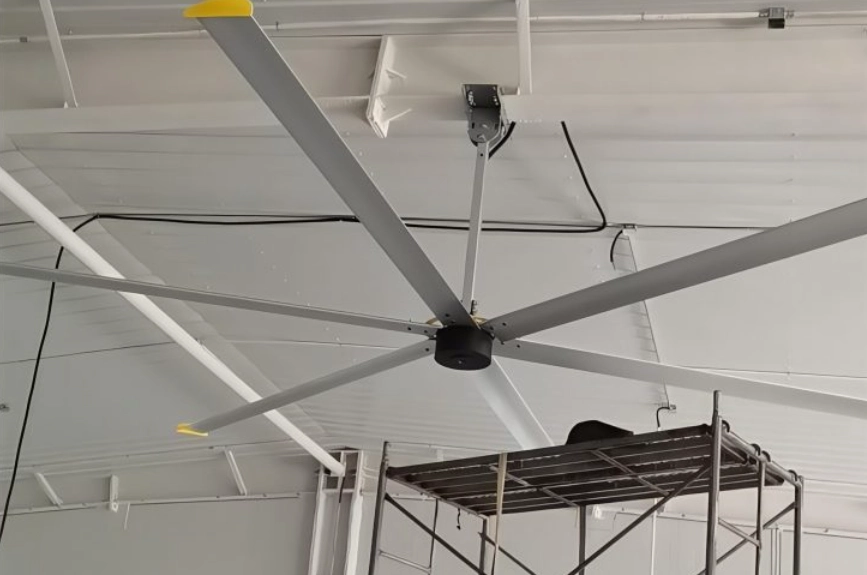
Large industrial buildings often face several airflow issues at once. Heat often accumulates near the roof area. Machines generates additional heat during operation. Storage racks break up normal air movement.
HVLS fans and traditional industrial fans can both improve airflow conditions. One creates wide air movement. The other directs air to a certain spot.
What Are HVLS Fans and How Do They Work?
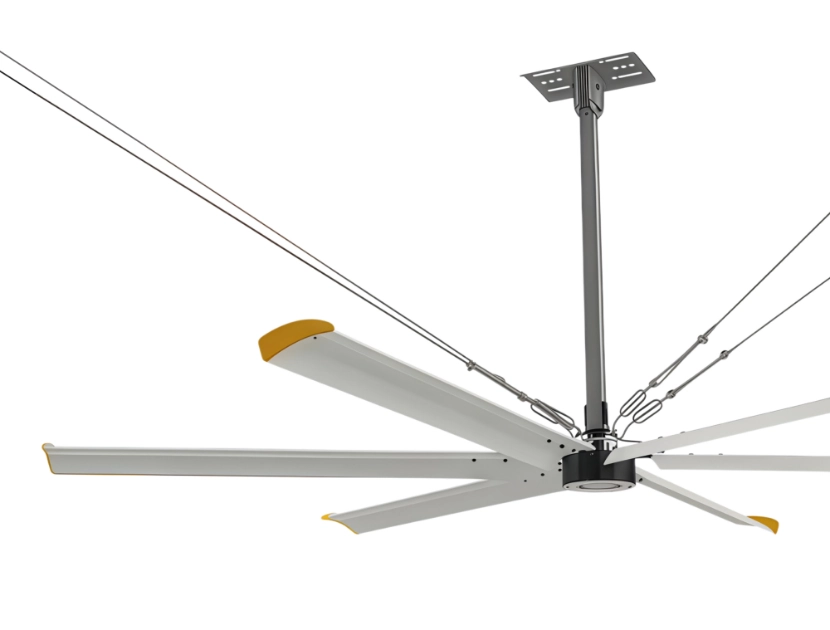
HVLS means high volume, low speed. These ceiling mounted fans use long blades. They run at low rotational speed. This design moves a large volume of air efficiently.
The result is not a sharp blast. It forms wide, steady airflow. The flow covers much of the building.
Large Diameter and Low Speed Operation
A large blade diameter allows each rotation push more air. Lower operating speeds reduce harsh and turbulent airflow sensations. Smaller high speed fans often create stronger and more turbulent airflow.
In a high warehouse, airflow right below a small fan may seem strong. However, the airflow effect often decreases quickly a few metres away.
Air Circulation Across a Large Area
Air moves downward from the fan and spreads across the floor before rising around walls, racks and equipment.
In an open logistics centre, this pattern helps cut stagnant areas. It helps create more consistent conditions at floor level. Warm spots may stay near loading doors or machinery. Still, the space usually feels less uneven.
What Are Traditional Industrial Fans?
Traditional industrial fans include wall mounted fans, pedestal, drum, floor and smaller ceiling fans. Most run at higher speeds. They send air toward a set area.
They work well at packing stations, welding bays, loading docks and production lines. A portable drum fan beside a hot machine may prove more useful. It may provide better local cooling than a ceiling fan installed far away.
The limitation shows when many zones need coverage. More fans create more wiring. They raise noise levels and add maintenance points.
How Do HVLS Fans and Traditional Industrial Fans Compare?
The main difference lies in the airflow pattern. It is not simply physical size.
| Comparison Factor | HVLS Fans | Traditional Industrial Fans |
| Airflow pattern | Broad and distributed | Concentrated and directional |
| Typical coverage | Large open areas | Local work zones |
| Operating speed | Low | Medium to high |
| Number of units | Often fewer | Often more |
| Installation | Usually ceiling mounted | Wall, floor, pedestal or ceiling |
| Floor space | None | Some models occupy floor space |
| Noise | Usually lower at working level | Often higher near the unit |
| Best use | Whole space circulation | Targeted cooling |
A site check matters more than a table. A large fan in the wrong position can perform poorly. A small fan aimed at the right workstation can solve a real problem at low cost.
Which Type Provides Better Airflow Coverage in Large Spaces?
HVLS fans usually give better coverage in open, high ceiling buildings. A single unit can influence airflow across a wide floor area. It reduces the need for several separate fans.
Traditional fans create higher air velocity in a narrow path. Once outside this airflow path, the effect drops quickly.
Tall racks, partitions and enclosed work cells can interrupt broad circulation. In those places, several directional fans may deliver air more effectively.
Coverage should be judged from the floor plan. Total floor area alone does not provide enough information for fan selection.
Which Fan Type Is More Energy Efficient?
Industrial HVLS fans can use less total energy. This happens when a few large units replace many smaller fans. However, this does not make every HVLS installation efficient.
When only one workstation needs cooling for a few hours, a traditional fan may use less energy overall.
The useful calculation should consider system level consumption. It covers motor power, number of units, operating hours and normal speed setting. Rated power for one fan tells only part of the story.
In air conditioned buildings, improved circulation may cut temperature differences. Actual savings depend on insulation, door openings, climate and schedules.
Which Option Is Easier to Install and Maintain?
Traditional fans are easier to install, move and replace. A pedestal or drum fan may need little more than a safe position and power connection.
HVLS fans require structural checks. The mounting point must support the fan and its operating loads. Clearances from beams, lights, sprinklers, cranes and stored goods also need review.
Fewer units may reduce the number of motors to maintain. However, maintenance access can be more challenging. Servicing a ceiling fan in a tall warehouse usually requires lifting equipment.
Which Fan Is Better for Different Industrial Applications?
Application matters more than product category. The same facility may require more than one airflow solution.
When HVLS Fans Are Usually the Better Choice
HVLS fans suit warehouses, logistics centres, high roof factories, hangars, sports halls and agricultural buildings.
They work best in open layouts. The goal is broad circulation. Keeping floor space clear is valuable for forklifts, storage or equipment.
When Traditional Industrial Fans Are More Suitable
Traditional fans fit smaller workshops, loading docks, individual workstations and temporary cooling zones.
They are also practical in low buildings or spaces with many obstructions. A wall fan can be angled toward a difficult corner. A portable fan can move when the process changes.
When a Combined System May Work Best
Many large facilities can benefit from combining both airflow approaches.
An HVLS fan can circulate air through the main warehouse. Wall or floor fans handle loading bays, mezzanines and hot production areas. Exhaust fans may still be required for fumes, moisture or process heat. Air circulation is not the same as air extraction.
What Should You Consider Before Choosing a Fan?
Start with the building, not the catalogue.
Measure floor area and ceiling height. Mark racks, machinery, walls, lights, sprinklers and crane paths. Identify occupied areas and where heat builds during a normal shift.
Define the primary cooling objective. It may be whole space circulation, local worker comfort, moisture control or support for an HVAC system.
The purchase price is only one part of the total investment. Installation cost, number of units, operating hours, maintenance access and structural requirements can change the better choice quickly.
Conclusion: Which Is Better for Large Spaces?
HVLS fans are usually stronger for broad circulation in open, high ceiling buildings. Traditional industrial fans are better for direct, local or temporary airflow.
Some facilities may only need one approach, while many benefit from a combination of both.
Compare fan diameter, airflow, motor power, mounting requirements and building layout. A well positioned fan often delivers more value than a larger fan chosen only from a specification sheet.
Optimize Your Industrial Airflow with DAIHO Ventilation
Every facility has unique airflow challenges and cooling requirements. DAIHO Ventilation provides customized HVLS fan and industrial ventilation solutions designed for warehouses, factories, logistics centres and large commercial spaces.
Contact our experts today for a tailored airflow assessment and efficient cooling solution.
FAQ
Q: Can HVLS fans replace air conditioning?
Usually not. They move air and improve perceived comfort. They do not remove heat. They can support air conditioning by improving distribution.
Q: Are HVLS fans suitable for warehouses with tall racks?
Sometimes. Tall racks can block horizontal airflow. Fan position and aisle arrangement must be checked.
Q: How many industrial fans does a warehouse need?
Floor area alone is not enough. Ceiling height, obstructions, fan diameter and occupied zones all affect the number.
Q: Are traditional industrial fans cheaper?
They usually cost less per unit. A large building may need many units. This makes the total cost less attractive.
Q: Can HVLS fans and exhaust fans work together?
Yes. HVLS fans circulate indoor air. Exhaust fans remove hot, humid or contaminated air.
 English
  Russian
  Arabic
  Spanish
  French
  Italian